UK Unemployment Unexpectedly Falls to 4.6% as Vacancies Hit 12-Year Low
Britain's jobless rate dipped to 4.6% in the three months to September, but vacancies, payrolls and pay growth all point to a weak labor market.
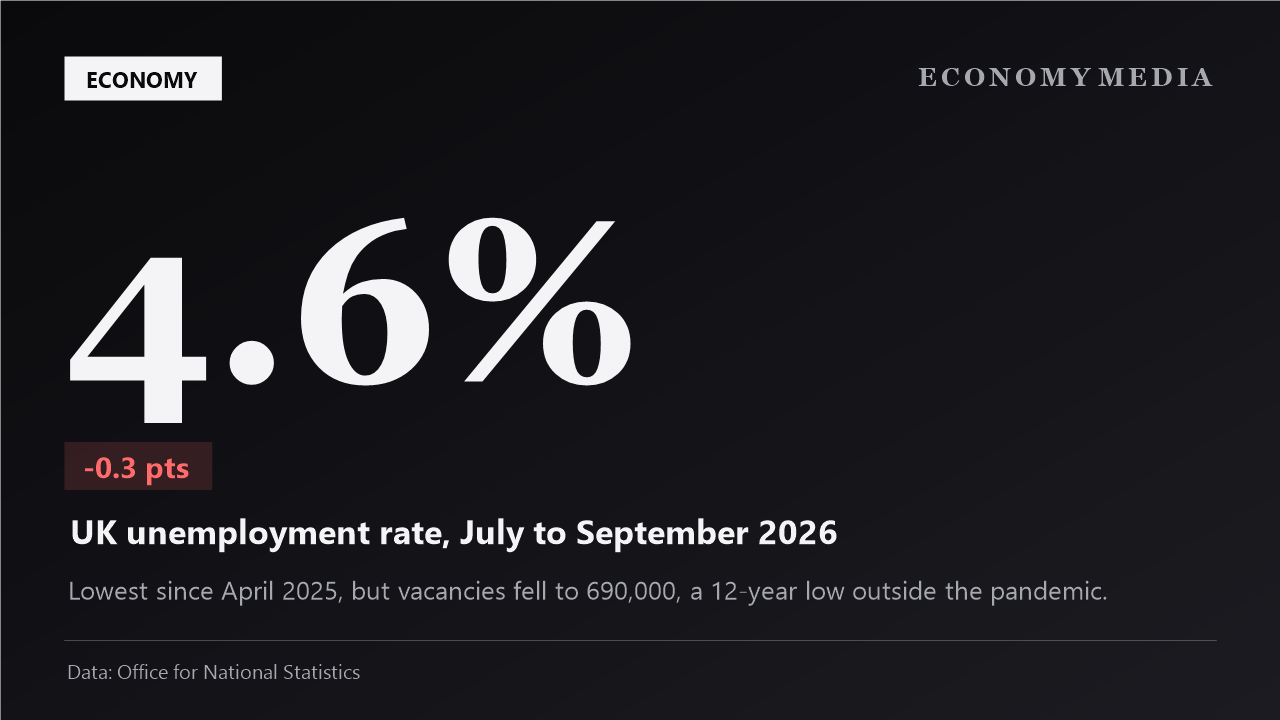
Britain’s unemployment rate fell unexpectedly to 4.6% in the three months to September, the Office for National Statistics (ONS) said on Tuesday. The headline improvement came alongside weaker signals elsewhere: job vacancies dropped to their lowest level in about 12 years outside the pandemic, the number of workers on company payrolls kept shrinking and wage growth cooled.
The figures arrive less than two weeks after the Bank of England raised interest rates for the first time since 2023. They add to a debate over how quickly the U.K. economy is losing momentum while energy-driven inflation climbs.
What the numbers show
According to the ONS, 1.684 million people were unemployed between July and September. The rate of 4.6% was 0.3 percentage points lower than in the previous quarter and a year earlier, FE News reported in its breakdown of the release. The Press Association said the rate had eased from 4.7% in the three months to August and was the lowest since April 2025. The employment rate for people aged 16 to 64 rose to 75.4%.
Other measures were weaker. Key figures from the release:
- Vacancies: 690,000 in August to October, down 22,000, or 3%, from the prior three months. That was the steepest quarterly fall since mid-2025. Small firms with one to nine employees accounted for the whole 22,000 drop.
- Payrolls: An early estimate put payrolled employees at 30.2 million in October. That was 34,000 fewer than in September and 95,000 fewer than a year earlier. The October figure may be revised.
- Pay: Regular pay, which excludes bonuses, grew 3.5% a year, down from 3.7%. Total pay growth slowed to 3.6%, its weakest pace since 2020.
- Claimant count: 1.714 million people claimed unemployment-related benefits in October, up on both the month and the year.
Liz McKeown, director of economic statistics at the ONS, called it a “mixed picture overall.” She said employers reported that higher labor and operating costs were affecting their hiring decisions. She added that the slowdown in regular pay growth was driven by public-sector wages. Public-sector regular pay rose 5.4%, compared with 3.1% in the private sector.
Why the drop may overstate the improvement
Several analysts warned against reading too much into the lower jobless rate. According to Personnel Today, the ONS said part of the fall reflects changes to the sample of its labor force survey. That survey has struggled with low response rates in recent years.
Naomi Clayton, chief executive of the Institute for Employment Studies, a research organization, said hiring “remains weak.” James Cockett, a senior labor market economist at the Chartered Institute of Personnel and Development (CIPD), a professional body for human-resources staff, called the data “a flicker of relief.” He added that the labor market is “still largely stalled.”
Inflation is also eating into pay gains. Estimates of real, inflation-adjusted pay growth vary with the price measure used. Personnel Today put real regular pay growth at 0.2% using CPIH, a version of the consumer price index that includes owner-occupiers’ housing costs. FE News put it at 0.4% using a measure that excludes those costs. The Resolution Foundation, a think tank focused on living standards, expects real wage growth to turn negative by winter as inflation rises.
The interest-rate backdrop
On Nov. 5, the Bank of England raised its benchmark rate by a quarter point to 4%, Reuters reported. Its Monetary Policy Committee voted 8-1, with one member, Catherine Mann, favoring a larger half-point increase. Consumer price inflation was 3.5% in September. The central bank expects it to reach about 5% in mid-2027, mainly because conflict in the Middle East has pushed up energy costs.
Andrew Bailey, governor of the Bank of England, said the increase “should not be seen as the first in an inevitable long sequence of hikes.” He also said it was unlikely to be the last unless the Middle East conflict is resolved.
Tuesday’s data may sharpen that debate. Jack Kennedy, a senior economist at the jobs site Indeed, said pay growth was still too strong for policymakers. In his view, that supports “the case for a rapid fire second rate hike in successive months.” For households, slower hiring, falling vacancies and rising borrowing costs point to a tougher winter even with fewer people out of work.
Young people in focus
The release came as the government prepared to publish a major review of youth employment led by Alan Milburn, a former Labour health secretary. Unemployment among 16- to 24-year-olds stood at 15.1%, more than three times the overall rate. The Learning and Work Institute, a policy group, estimates that around one million young people are not in education, employment or training, a level last exceeded in 2013. There was one brighter sign: payrolled employment among 18- to 24-year-olds rose by 34,000 over the quarter, Personnel Today reported, while the number for workers aged 25 and over fell.
The Bank of England’s next rate decision is scheduled for Dec. 17.