IMF Chief Warns AI Boom Will Push Interest Rates Higher Worldwide
IMF head Kristalina Georgieva told APEC leaders that AI demand and the energy shock will lift global inflation to 4.7% this year, calling for tighter policy.
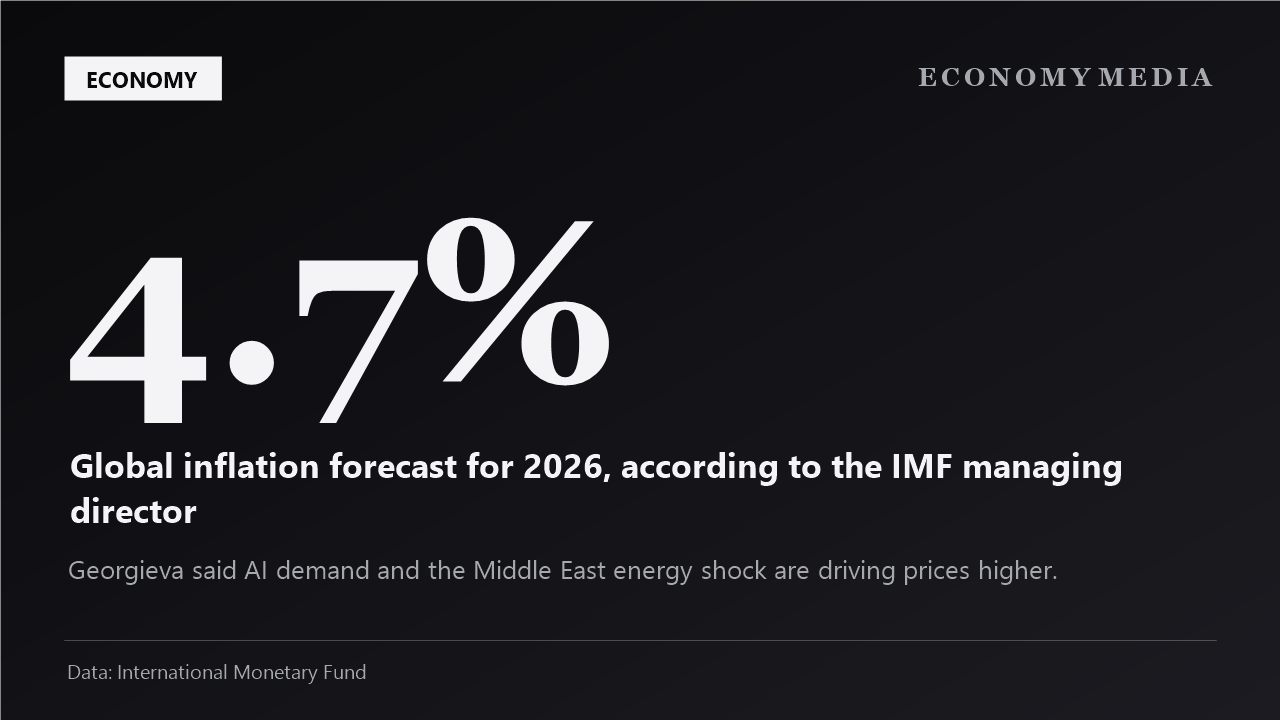
Booming demand for artificial intelligence is adding to price pressures around the world and will push major central banks to raise interest rates further, Kristalina Georgieva, managing director of the International Monetary Fund (IMF), warned on Thursday. Speaking at the Asia-Pacific Economic Cooperation (APEC) summit in Shenzhen, China, she said the combination of AI-driven demand and the energy shock from the war in the Middle East would lift global inflation to 4.7% this year, according to The Guardian.
What happened
Georgieva, who leads the Washington-based lender that monitors the health of the world economy, said demand for AI hardware and related technology products is now pushing up consumer prices globally. Layered on top of higher energy costs, that demand is adding to inflationary pressure, she said. “This calls for a tightening of monetary policy in many economies,” she told the gathering, The Guardian reported.
APEC is a forum of 21 economies around the Pacific Rim, including the United States, China, Japan and Russia. The Associated Press reported that Georgieva told leaders AI was having a “material impact” on global growth and was helping to offset the damage from the energy shock. She cited figures showing APEC economies, which account for more than half of global business activity, growing at an annual pace of 3.4%, slightly ahead of global growth of 3.1%. Global trade, she said, has expanded at 4.6%, largely because of the AI investment boom.
Why it matters for households
Higher central bank rates feed through to the cost of mortgages, car loans and credit card balances, and the IMF chief’s comments suggest that relief on borrowing costs may be further off than many families had hoped. Several major central banks have already reversed course this year after the Middle East war broke out in February and pushed oil above $100 a barrel, reigniting inflation, The Guardian reported.
- The European Central Bank raised rates in June, its first increase since 2023.
- The U.S. Federal Reserve raised rates in September.
- The Bank of England raised rates earlier this month, its first increase in more than three years.
According to The Guardian, financial markets expect further increases in borrowing costs next year as AI spending keeps economic growth firm. Oil prices have eased in recent weeks, following the U.S. midterm elections and a rise in crude supply, which could take some pressure off energy bills.
AI as a lasting force
Georgieva drew a sharp distinction between the two shocks. “While the energy shock will eventually dissipate, AI is forever,” she said, according to the AP, describing the technology as “the most significant factor for medium-term competitiveness, productivity, and growth.” She also called it “the fastest transformation in human history.”
The Guardian reported that AI hardware and related tech products now make up more than one-tenth of world goods trade, a share that is rising quickly, and that some countries are benefiting far more from the investment wave than others. Georgieva urged governments to build digital infrastructure, prepare labor markets and workers for AI, and manage risks, particularly to financial stability and cybersecurity. Summing up her message, she said: “you snooze, you lose.”
Risks and what comes next
The outlook is not without hazards. Economists warn that high inflation squeezing household budgets could slow consumer demand, while fears of an AI bubble and volatile stock markets could lead businesses to pull back on investment, The Guardian noted. Either development could cool the growth that the IMF says AI is currently supporting.
Georgieva’s remarks came at a summit dominated by geopolitics. The AP reported that Chinese President Xi Jinping opened the closed-door leaders’ meeting by urging members to unite behind open trade and technology development, while U.S. President Donald Trump vowed to oppose what he called “globalist” efforts to regulate or stifle AI. Russian President Vladimir Putin made his first APEC appearance in nine years. For central banks, the key question heading into 2027 is whether AI-fueled demand keeps prices elevated even as the energy shock fades.