Japan’s Exports Jump 20.5% to Record as AI Chip Demand Surges
Japan's October exports rose 20.5% to a record 11.8 trillion yen on AI-related chip demand, while costly oil kept the country in a trade deficit.
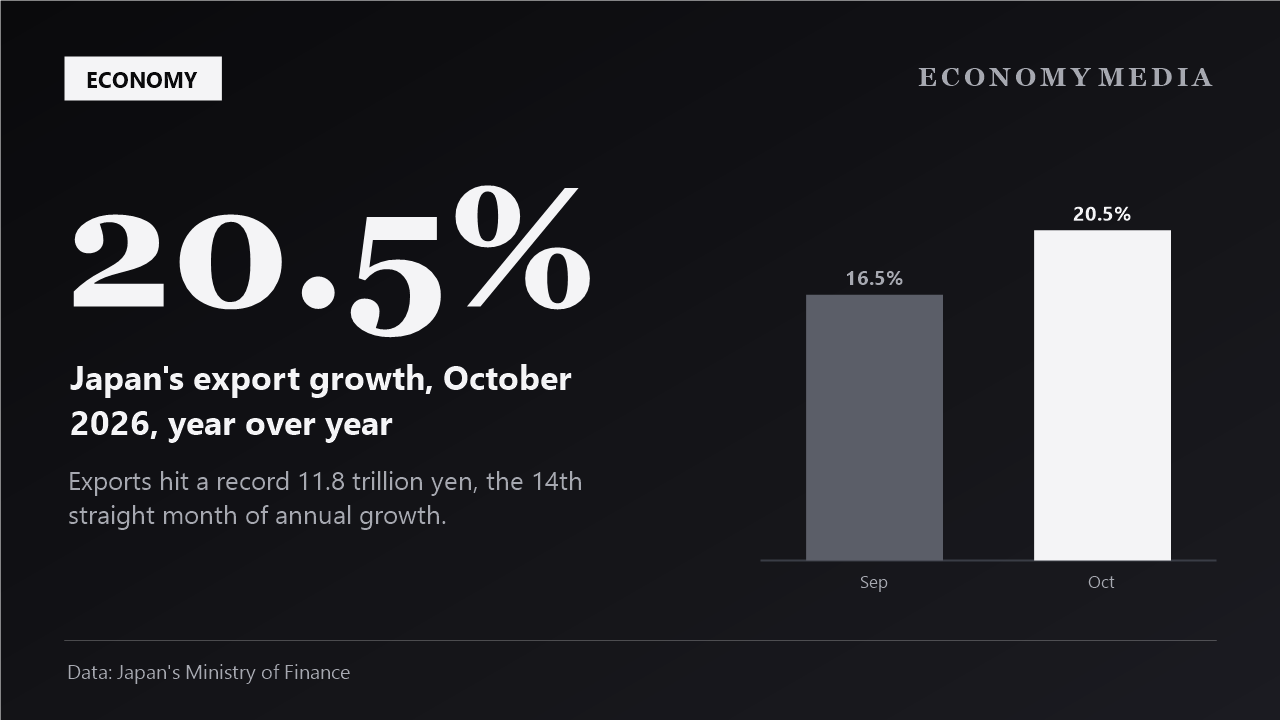
Japan’s exports climbed 20.5% in October from a year earlier to the highest monthly total on record, as global spending on artificial intelligence drove demand for semiconductors and chipmaking equipment, according to preliminary data from Japan’s Ministry of Finance released Wednesday. Imports grew even faster, however, leaving the world’s fourth-largest economy with a trade deficit for a sixth straight month.
What happened
Exports reached about 11.8 trillion yen, or roughly $74 billion, Reuters reported, calling it the highest figure for any single month on record. China’s state news agency Xinhua put the precise total at 11.77 trillion yen. The increase slightly beat the 20% median forecast of economists polled by Reuters and marked the 14th consecutive month of year-over-year export growth. It also followed a revised 16.5% gain in September, ending a two-month slowdown, CNBC reported.
Chip-related goods led the gains. Shipments of semiconductor equipment rose 49.7% by value, while motor vehicle exports, a pillar of Japanese manufacturing, increased 19.9%, according to CNBC.
Imports rose 21.6% to about 12.25 trillion yen, also a record for the month, Xinhua said. That was well below the 25.8% increase analysts had expected, which helped keep the shortfall small. The trade deficit came to 476.5 billion yen, roughly $3 billion, about half the 956 billion yen gap economists had forecast, Reuters reported.
Demand rose across major markets. Exports to the United States, Japan’s biggest single-country customer, grew 23.9%. Shipments to the European Union rose 22.1%, and exports to Asia as a whole rose 22%, according to Xinhua. Exports to China lagged at 13.3%, CNBC and Reuters reported.
Why it matters
The headline figures overstate how much more Japan is actually shipping. Export volume rose just 5.8%, Xinhua reported, which means most of the jump in value came from higher prices rather than more goods leaving the country. Economists told Reuters that companies passing higher costs on to buyers had pushed up the nominal value of exports.
The import side tells a similar story. Import volume dipped 0.2%, yet the bill hit a record because oil and shipping have become more expensive amid instability in the Middle East. CNBC reported that the value of petroleum imports rose 60.5% even as volumes fell 0.7%. Purchases of oil from the Middle East fell 16.5% by volume but rose 37.7% in value, while imports from the United States jumped more than 1,100% by value, according to CNBC.
For Japanese households, those costlier imports matter. Reuters reported that rising import costs are likely to squeeze consumers’ purchasing power and companies’ profit margins. The yen, which traded around 159.50 per dollar after the release according to CNBC, makes imported fuel and food more expensive for Japanese buyers.
Background
Trade has become one of the few bright spots for Japan’s economy. Separate government data showed gross domestic product, the broadest measure of economic output, shrank at an annualized rate of 0.1% in the July-to-September quarter, a contraction that surprised forecasters. Reuters attributed the decline to weak consumer spending as higher living costs forced households to cut back.
The strong export numbers lifted Japanese stocks modestly. The Nikkei 225, Tokyo’s benchmark stock index, rose 0.91% after the data, CNBC reported.
What comes next
The outlook depends heavily on whether worldwide spending on AI infrastructure holds up. Analysts told Reuters that chip-related demand has helped offset sluggish demand from China, but policymakers remain wary of two risks: a possible slowdown in AI-related investment and a further escalation of conflict in the Middle East that could push energy prices higher.
The October figures are preliminary, and the Ministry of Finance typically revises monthly trade data as more complete information becomes available.