UnitedHealth Shares Tumble on CMS Medicare Advantage Fraud Rule
Health insurer stocks fell for a second day after Medicare regulators proposed an anti-fraud rule that could claw back billions in overpayments.
Shares of UnitedHealth Group, the largest private operator of Medicare Advantage plans, fell sharply for a second straight day on Wednesday, Nov. 18, after federal regulators proposed a sweeping anti-fraud rule that could force insurers to repay billions of dollars in past overpayments. Rivals Humana, CVS Health and Cigna also slid as investors tried to gauge how much the proposal could cost the industry.
What happened
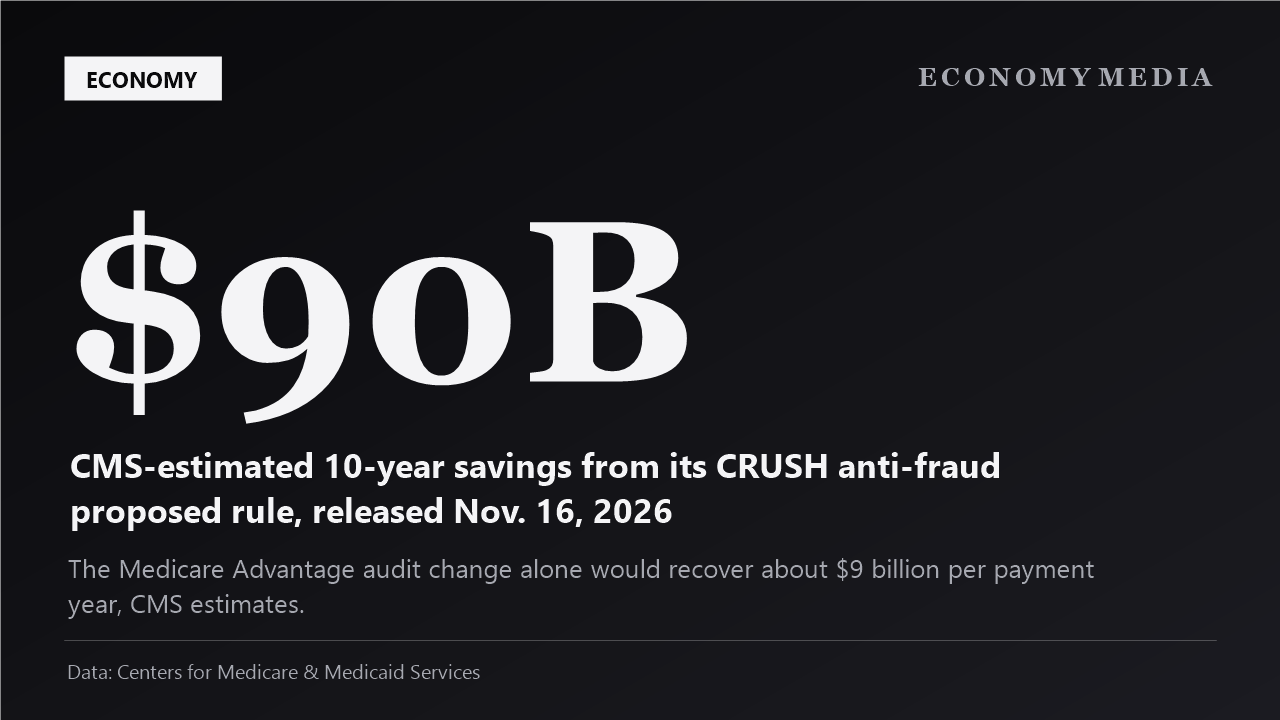
The Centers for Medicare & Medicaid Services (CMS), the federal agency that runs Medicare and Medicaid, released the proposal on Monday, Nov. 16. It is called the Comprehensive Regulations to Uncover Suspicious Healthcare rule, or CRUSH. In a press release, CMS said the package could save taxpayers nearly $90 billion over 10 years across Medicare, Medicaid, the Children’s Health Insurance Program and the Affordable Care Act marketplace.
The market reaction built over two sessions. UnitedHealth closed down 5.42% at $389.68 on Tuesday, Nov. 17, with Humana down 5.48% and CVS down 3.48%, according to figures compiled by the financial news site MLQ.ai. On Wednesday, Seeking Alpha reported UnitedHealth was down just over 8% at $356.89 in midday trading. A Yahoo Finance analysis published that afternoon put the day’s decline at 12%, with CVS down 5% and Cigna down 3%. The figures differ because they were captured at different points in a volatile session.
What the rule would do
The provision that most worries investors concerns risk adjustment data validation audits, known as RADV. Medicare pays private Medicare Advantage plans more for enrollees whose medical records show more serious health conditions, and RADV audits check whether those diagnoses are supported by patient charts.
Under the proposal, CMS would extrapolate errors found in a sample of charts to an insurer’s entire contract, starting with payment year 2018, according to MLQ.ai’s summary of the rule. The agency estimates that change alone would recover about $9 billion per payment year. The proposal would also drop a so-called fee-for-service adjuster, which would have allowed for coding errors that also occur in traditional Medicare.
Other key provisions include:
- Requiring Medicare Advantage and Part D drug plans to report suspected or substantiated fraud to CMS. MLQ.ai, citing the agency, reported that only 46% of plan contracts voluntarily made such referrals in 2025.
- Requiring doctors and suppliers who bill Medicare Advantage plans to enroll in traditional Medicare.
- Requiring providers to report enrollment changes within 30 days, and letting CMS deny or revoke enrollment when owners cannot be verified, according to the CMS press release.
- Barring marketplace agents and brokers with certain felony convictions or federal health care exclusions.
“Every taxpayer dollar lost to fraud is a dollar that cannot support the care these programs were created to provide,” Dr. Mehmet Oz, the CMS administrator, said in the agency’s statement. Robert F. Kennedy Jr., the secretary of Health and Human Services, said the rule would give CMS “stronger tools to block fraudulent payments.”
Why it matters
Medicare Advantage is an alternative to traditional, government-run Medicare in which private insurers manage benefits for seniors in exchange for monthly payments from the government. For some companies it is the core of the business: Humana drew $99.4 billion of its $129.7 billion in 2025 revenue from Medicare Advantage, Yahoo Finance reported. Cigna, by contrast, sold its Medicare Advantage business in March 2025, which helps explain its smaller decline.
Analysts are still working out the real financial hit, and the companies have not published estimates of their own exposure. Analysts at the investment bank Oppenheimer expect legal challenges similar to those that sank a comparable framework in 2025, Yahoo Finance reported, and noted and noting that plans would likely “incorporate the prospective cost into bids” even if the rule survives. That raises the possibility that some of the cost could eventually show up in the benefits or premiums plans offer seniors.
The pressure on insurers also has a political dimension. Sen. Elizabeth Warren, a Massachusetts Democrat, called on X for breaking up UnitedHealth, CVS Health and Cigna, arguing that the companies “take a cut at every step” because each owns an insurer, a pharmacy benefit manager and pharmacies.
What comes next
The rule is only a proposal. CMS is accepting public comments until Jan. 19, 2027, before it can issue a final version. Its path is uncertain: in September 2025, a federal judge in the Northern District of Texas vacated similar audit provisions from a 2023 CMS rule in a case brought by Humana, finding the agency had not followed required procedures. CMS is appealing that decision.
Oppenheimer expects most recoveries, if they happen, to fall in 2028 through 2030, according to Yahoo Finance. Investors will also be watching UnitedHealth’s 2027 financial outlook, which the company plans to release before year-end, for any sign of how it expects the proposal to affect earnings.