NASA’s Voyager 1 Becomes First Spacecraft One Light-Day From Earth
After 49 years in flight, NASA's Voyager 1 is now so far away that a radio signal needs a full day to reach it, a first for any human-made object.
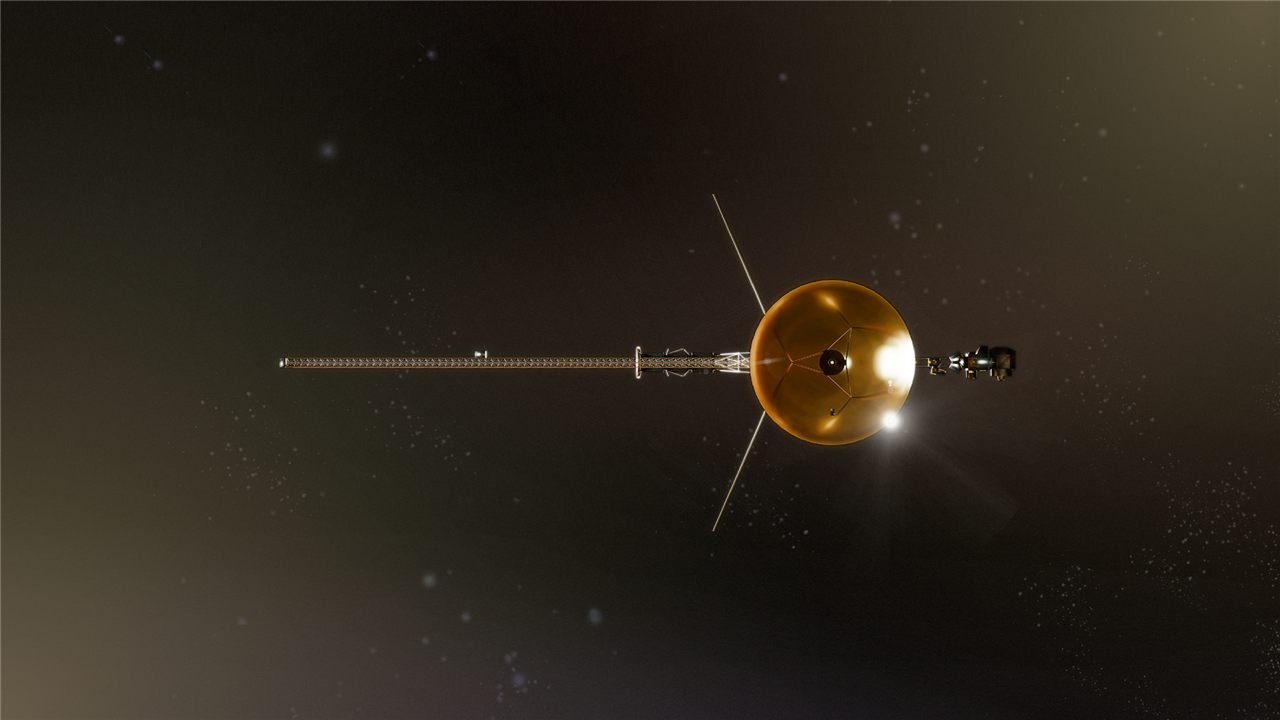
Voyager 1, the NASA probe launched in 1977, has become the first human-made object to reach one light-day from Earth. At that distance, about 16.1 billion miles away, a radio signal traveling at the speed of light needs a full 24 hours to cover the gap. EarthSky, an astronomy news site, said the spacecraft crossed the mark at 10:16:07 UTC on Wednesday, Nov. 18, which is 5:16 a.m. Eastern time.
What happened
The crossing came 49 years, 2 months and 11 days after Voyager 1 launched on Sept. 5, 1977, according to EarthSky. One light-day works out to roughly 25.9 billion kilometers, or about 173 astronomical units. One astronomical unit is the average distance between Earth and the sun.
The milestone is hard to watch in real time. Engadget noted that because signals take a day to travel each way, NASA can only confirm the moment once the probe’s next transmission arrives, a day later. Sending a command and getting a reply now takes about two days.
Kareem Badaruddin, the Voyager mission manager at NASA’s Jet Propulsion Laboratory (JPL) in Southern California, told Engadget the event was unprecedented. “It’s never happened before, and it may never happen again,” he said.
Suzanne Dodd, the Voyager project manager at JPL, called the spacecraft “a national treasure” in an interview with The Associated Press. She also described it as “the little engine that could.”
An aging explorer still at work
Voyager 1 and its twin, Voyager 2, were built to explore the outer planets. Voyager 1 flew past Jupiter and Saturn. Voyager 2 completed a “Grand Tour” that also took in Uranus and Neptune. In 2012, Voyager 1 crossed the heliopause, the outer boundary of the sun’s bubble of charged particles, and became the first spacecraft to enter interstellar space. Voyager 2 followed in 2018.
Both probes run on generators powered by decaying plutonium, and their power supply shrinks every year. To keep them running, engineers have switched systems off one at a time. EarthSky reported that NASA turned off Voyager 1’s Low-Energy Charged Particle instrument, which measured electrons, ions and cosmic rays, in April 2026. The agency has said it could be turned back on later. The AP reported that controllers finished their latest power-saving step in September. In October the spacecraft briefly lost contact with Earth, and the cause was still under investigation.
Even so, the probe keeps sending science data. The AP said Voyager 1 returns readings almost every day on:
- the strength and direction of the magnetic field around it
- pressure and dust
- galactic cosmic rays, the high-energy particles that come from beyond the solar system
Engineers send commands about once a week. The AP reported that the team steps up its work when problems come up, sometimes with help from retirees.
Why it matters
No other spacecraft has gone this far. Voyager 1 launched 16 days after Voyager 2, but it has since traveled farther than its twin. According to the AP, both probes are traveling at about 38,000 miles per hour, in different directions. EarthSky said Voyager 2 is about 2 billion miles closer to Earth and moving more slowly, so it will never catch up. NASA expects Voyager 2 to reach one light-day in November 2035.
The figures also show how far away other stars are. The AP reported that Voyager 1 would need about 18,000 more years to reach one light-year from Earth, and more than twice that long before it comes near another star. Engadget said the probe is heading toward Gliese 445, a star about 17 light-years away in the constellation Ursa Minor, and should pass within 1.7 light-years of it in about 40,000 years. EarthSky described Voyager 1’s path as heading “up” out of the plane of the planets, toward the constellation Ophiuchus. The two outlets describe the direction in different terms.
Celebrations and what comes next
NASA invited the public to mark the event by flashing “VGR,” the spacecraft’s call sign, in Morse code with phones or flashlights after sunset on Tuesday, Nov. 17. The Planetary Society, a nonprofit space advocacy group, planned a free livestream on Wednesday evening with Dodd, Badaruddin and Linda Spilker, the Voyager project scientist. Bill Nye, the society’s chief ambassador, said in remarks reported by the AP and EarthSky that “everyone on Earth” has been touched by the missions.
Each Voyager carries a Golden Record, a gold-plated disc with sounds and images meant to represent life on Earth, in case another civilization ever finds it. Dodd told the AP she hopes “something, someone, finds it maybe 1,000 years from now.”
NASA has not set a date for the end of the mission. Each year the plutonium supply weakens, so more systems are likely to be turned off. For now, both Voyagers are still sending data home.