Nasdaq Pares 4% Plunge as Nvidia Leads AI Sell-Off; Dow Ends Higher
The Nasdaq fell more than 4% intraday Wednesday as Nvidia's comeback rally faded, before recovering most of the loss. The Dow erased a 1,100-point drop.
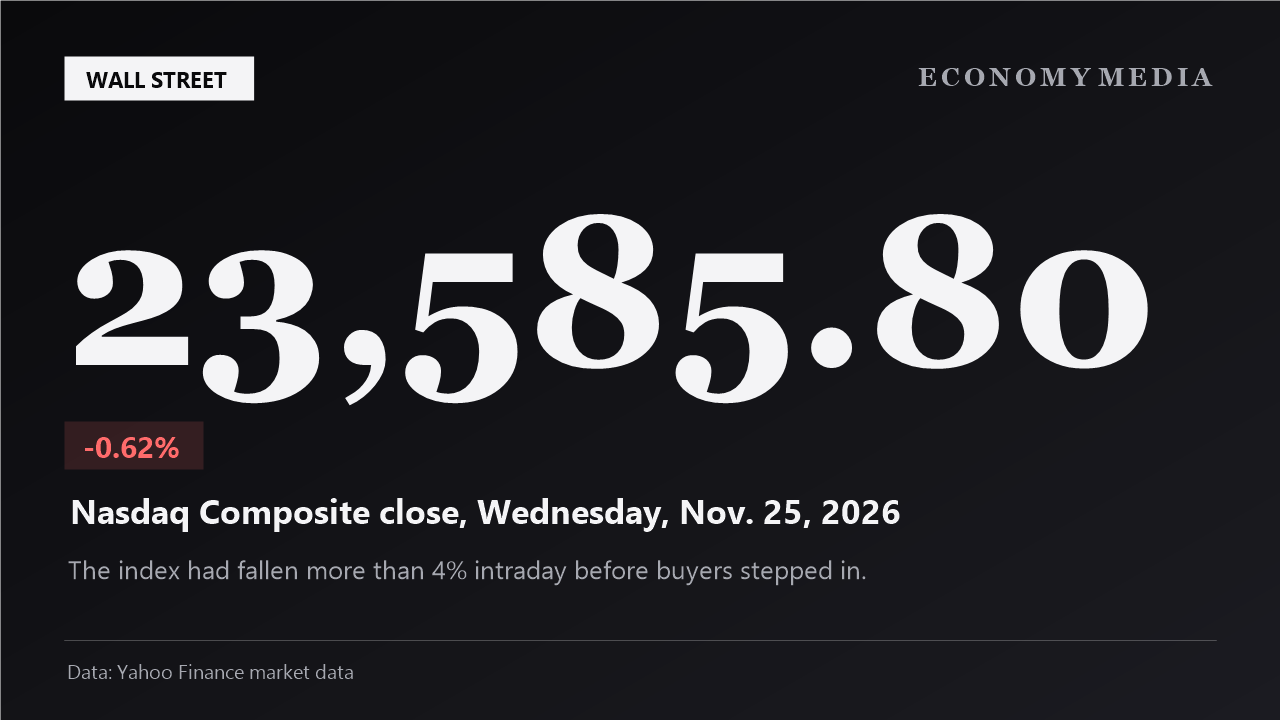
Wall Street lived through one of its most volatile sessions of the year on Wednesday, Nov. 25, as a fresh sell-off in artificial intelligence stocks led by Nvidia sent the Nasdaq Composite down more than 4% before buyers stepped in. By the close, the technology-heavy index had cut its loss to 0.62%, ending at 23,585.80, according to Yahoo Finance market data, while the Dow Jones Industrial Average recovered from a drop of about 1,100 points to finish slightly higher.
The S&P 500 slipped 0.25%, or 18.31 points, to 7,182.78. The Dow rose 164.25 points, or 0.33%, to 50,182.95. The New York Post, in a report syndicated by Yahoo Finance, said the Nasdaq had tumbled as much as 4.1% by late morning, while The Wall Street Journal put the index’s deepest intraday decline at 4.5%. The varying figures reflect how quickly prices moved through the day.
What happened
The selling centered on Nvidia, the world’s most valuable chipmaker, whose shares had posted one of their best days on record on Monday after the company reinstated Jensen Huang as chief executive. That rebound has since faded. CNBC reported that Nvidia slumped about 4% on Wednesday, and Yahoo Finance data showed the stock at $149.61 at the close, down $5.77, or 3.71%.
Other AI-linked names also fell. According to CNBC and the New York Post:
- Oracle dropped about 5%.
- Micron Technology lost about 4%.
- Amazon and Alphabet each fell around 2%.
- Microsoft declined more than 1%, as did Tesla.
- Meta Platforms bucked the trend, rising roughly 3%.
Anthropic, the AI developer that went public last week in what the New York Post described as the largest initial public offering ever, raising $81.3 billion, was a rare gainer. The stock had dipped below its $83 IPO price on Tuesday and set an intraday record low on Wednesday before rebounding. CNBC said it climbed more than 4% at one point, while the New York Post reported a gain of about 1% earlier in the session; Yahoo Finance data later showed it up 1.74% at $83.33.
Why investors sold
Several pressures converged. Huang’s return briefly revived appetite for technology shares, CNBC reported, but did not settle broader worries about the enormous cost of building AI infrastructure and whether that spending will pay off. The New York Post also cited concerns that the Democrats’ sweep in the midterm elections could slow approval of new data-center projects.
Inflation added to the strain. The personal consumption expenditures price index, the Federal Reserve’s preferred inflation gauge, rose to 3.8% in October, nearly twice the central bank’s 2% goal and 0.1 percentage point above September, according to the New York Post. Core prices, which exclude food and energy, came in slightly hotter than expected. Traders priced in a 94% chance that the Fed will raise its benchmark rate by a quarter point to a range of 4% to 4.25% at its Dec. 9 meeting, based on the CME FedWatch tool, which tracks futures-market bets on Fed policy. Higher rates tend to weigh most heavily on growth stocks such as technology companies.
Trade policy was another factor. The administration proposed a new round of tariffs targeting 14 trading partners, including China, Japan, India and the European Union, the New York Post reported.
What analysts said
Strategists offered sharply different readings of the swings. Venu Krishna, head of U.S. equity strategy at Barclays, told CNBC’s “Squawk on the Street” that “this is panic right now,” adding that the market appeared to be “expecting some sort of a macro shock.”
Chris Brigati, chief investment officer of SWBC, struck a more cautious tone in a note cited by the New York Post. He wrote that the downside risk from the AI trade had not passed because the “Jensen Huang stock put is fading,” a reference to the idea that Huang’s return had put a floor under the shares. Brigati said the S&P 500 could fall close to 6,500 by year-end and that a traditional year-end “Santa Claus rally” looked unlikely.
Jim Reid, a research analyst at Deutsche Bank, wrote that a “risk-off tone” had returned to markets, noting that defensive sectors such as health care and consumer staples were holding up better than technology.
What comes next
The sell-off came in a week shortened by the Thanksgiving holiday, with U.S. stock markets closed on Thursday. Investors will be watching whether Nvidia can stabilize after its whiplash week, and whether the Fed follows through on the rate increase that futures markets now see as all but certain. With inflation running well above target and tariff threats back on the agenda, Brigati wrote that the market was entering correction territory heading into the holiday.