Nissan Cuts Sales Forecast Again as China’s Shift to EVs Speeds Up
Nissan lowered its global sales target for a second time since August, saying China's move to electric cars is happening faster than it expected.
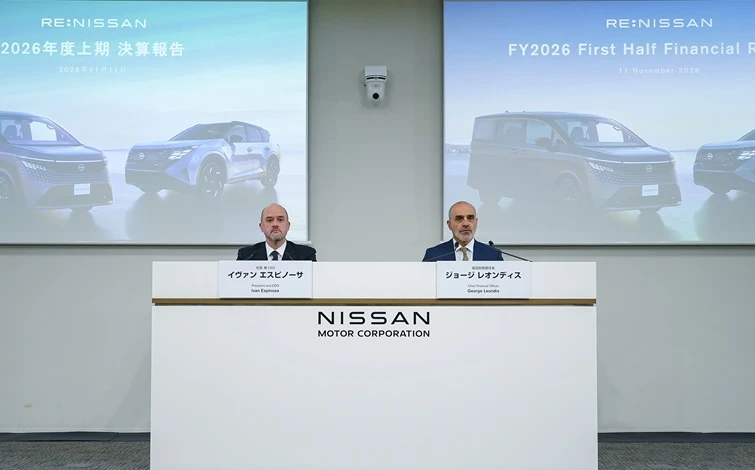
Nissan Motor lowered its full-year global sales forecast on Wednesday for the second time in three months. The Japanese automaker said Chinese buyers are moving to electric and hybrid cars faster than it had planned for, while a crowded field of local rivals is squeezing its share of the world’s largest car market. Nissan now expects to sell 2.97 million to 3 million vehicles in the fiscal year ending in March 2027, down from its earlier target of 3.15 million, according to the company’s earnings release.
The company kept its full-year operating profit forecast of 200 billion yen. It said cost cuts and stronger sales in the United States and Japan should make up for the weakness in China. Its quarterly profit, however, came in far below analyst expectations.
What happened
For the six months through September, Nissan reported net revenue of about 6.07 trillion yen, an increase of 493.3 billion yen from a year earlier. Operating profit was 80 billion yen, compared with a loss of 27.7 billion yen in the same period last year. The company sold 1.41 million vehicles worldwide in the half. It still posted a net loss of 39.7 billion yen, though that was 182.2 billion yen smaller than a year before.
The second quarter was much weaker. Operating profit for July through September fell 96% to 2.1 billion yen, or roughly $13 million, CNBC reported. Analysts polled by FactSet had expected about 54.9 billion yen. Nissan said the drop came mainly because a benefit from lower U.S. emissions-related expenses, which lifted profit a year earlier, did not repeat. Quarterly revenue rose 8.2% to about 3.1 trillion yen, roughly in line with forecasts, according to CNBC.
The results came out after the Tokyo market closed. Nissan’s Frankfurt-listed shares fell about 4% in early afternoon trading, and the stock is down 29% so far this year, CNBC reported.
The China problem
In its statement, Nissan blamed the lower outlook on “weaker demand, a faster-than-anticipated shift to” new energy vehicles, and “intensifying competition” in China. New energy vehicles is the term China uses for battery-electric cars, plug-in hybrids and fuel-cell models. The company said it is responding in several ways:
- Reducing production of gasoline-powered cars and cutting dealer inventory in China.
- Speeding up the launch of its N-series lineup of new energy vehicles built for Chinese buyers.
- Exporting more cars developed in China, increasing the number of such models from two to five and aiming at 12 regional market groups in the “very near term,” according to CNBC.
Ivan Espinosa, Nissan’s chief executive since April 2025, called China “our most significant challenge” and said the company needs “to remain agile.” CNBC reported that Espinosa said Nissan is building vehicles specifically for Chinese consumers, using local technology, lower costs and faster development times. He said those steps would let the company “defend ourselves from these very aggressive players.”
Nissan is not the only foreign automaker struggling there. CNBC noted that shares of Volvo Cars fell sharply in October after the Swedish carmaker swung to an operating loss, citing tough conditions in China and the United States. Håkan Samuelsson, Volvo Cars’ chief executive, said at the time that selling global cars developed in Europe and China “will not work,” according to CNBC.
Bright spots in the US and Japan
Outside China, the picture looked better. Nissan raised its sales outlook for both the United States and Japan. In the U.S., it said sales grew on the strength of the U.S.-built Rogue, Frontier and Pathfinder models, and that pricing and a richer mix of trim levels improved revenue quality. In Japan, the redesigned Elgrand minivan and the Kicks small SUV are attracting buyers, the company said. Espinosa said the first half showed “encouraging momentum” in those key markets.
Nissan said its turnaround program, called Re:Nissan, produced 110 billion yen in additional cost savings during the half. The plan includes shrinking the company’s global manufacturing footprint and cutting about 15% of its workforce. CNBC reported that about 18 months into the effort, Nissan has saved a total of 365 billion yen.
What comes next
Nissan expects 120 billion yen in operating profit in the second half of the fiscal year. It is counting on higher sales volumes, new models and more profitable vehicles, and it expects those gains to partly offset currency swings, higher raw material costs and the loss of a one-time tariff benefit it booked in the first half. Upcoming launches include a Rogue Hybrid in the U.S., the Frontier Pro plug-in hybrid pickup in Mexico and the Pixo electric car in Europe. The company also plans to reveal new Skyline and Patrol models in Japan and a Juke EV for Europe.
The company said it expects automotive net cash to exceed 1 trillion yen by the end of the fiscal year. It will present a new business plan in February 2027. Whether that plan can halt the slide in China, where Nissan is reshaping its lineup around electric and hybrid models, is still the biggest open question for the company.