Qualcomm Slides on Weak Outlook as Memory Shortage Hits Phone Chips
Qualcomm narrowly beat quarterly estimates, but a soft profit forecast and a 26% drop in handset chip sales sent its shares lower after hours.
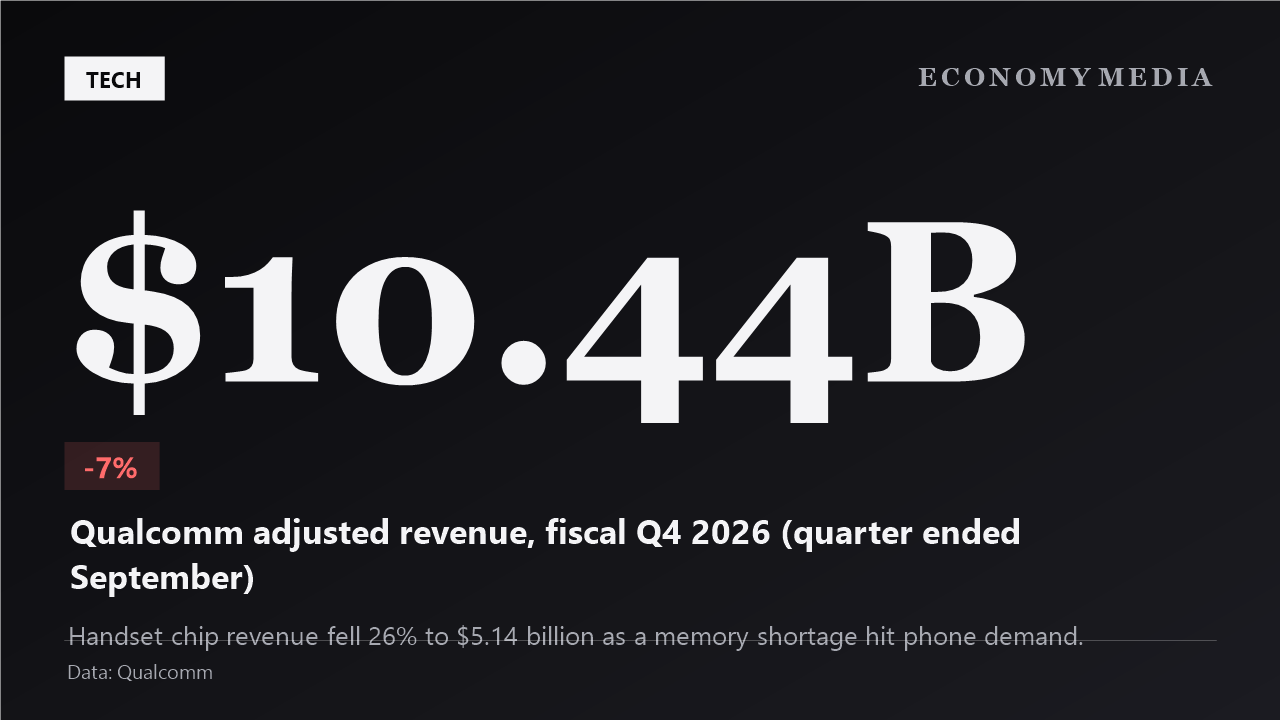
Qualcomm, the largest supplier of processors for Android smartphones, reported quarterly results on Wednesday that edged past Wall Street estimates, but its shares fell in after-hours trading after the company issued a profit forecast below analyst expectations and reported a steep drop in sales of its smartphone chips. A worldwide shortage of memory chips, which has pushed up the price of phones and laptops, continues to weigh on demand.
CNBC reported that the stock fell about 6% in extended trading, while Investing.com put the early decline at about 3%, a gap that reflects how volatile the after-hours move was.
What happened
For its fiscal fourth quarter, which ended in September, Qualcomm posted adjusted earnings of $2.17 per share, a cent above the $2.16 consensus compiled by LSEG, according to CNBC. Adjusted revenue came to $10.44 billion, down 7% from $11.27 billion a year earlier, CNBC and Investing.com reported. Yahoo Finance cited a slightly different revenue figure of $10.32 billion, against expectations of about $10.12 billion.
The weak spot was handsets. Revenue from smartphone chips fell 26% from a year earlier to $5.14 billion, slightly below analyst estimates. Other parts of the business performed better:
- Automotive: revenue jumped 89% to $1.99 billion, well above estimates and approaching $2 billion in a quarter for the first time, Investing.com noted.
- Internet of things (IoT): a unit that includes laptop chips, smart-glasses processors and low-power chips, grew 4% to about $1.88 billion.
- Licensing: QTL, the division that collects patent royalties from phone makers, posted revenue of $1.3 billion, down 7%. CNBC reported that Qualcomm renewed licensing agreements with Apple, Huawei and Transsion.
A forecast that fell short
For the current quarter, Qualcomm forecast adjusted earnings of $2.15 to $2.35 per share on revenue of $10.4 billion to $11.2 billion. The revenue range sits largely above analyst expectations, but the profit midpoint of $2.25 per share came in below forecasts. CNBC said analysts had expected $2.27, while Yahoo Finance and Investing.com cited a consensus of $2.32.
The company pointed to rising costs across its supply chain, including wafer fabrication, assembly and testing, advanced packaging and memory, Investing.com reported. Qualcomm raised its prices in September, according to CNBC, and expects those increases to deliver their full benefit in the second half of fiscal 2027.
The memory shortage is also hurting demand directly. Higher prices for memory and storage chips are forcing phone and laptop makers to charge more for their devices, which in turn reduces how many they sell and how many Qualcomm processors they need. Yahoo Finance noted that Apple warned this week that the memory crunch would keep squeezing its margins, and that Intel and AMD both expect PC sales to fall next quarter. Qualcomm said Android phone shipments in China appear to have bottomed and that it expects the handset market to be flat in 2027, CNBC reported.
Betting on data centers
Cristiano Amon, Qualcomm’s chief executive, is trying to reduce the company’s dependence on smartphones by expanding into cars, PCs and, most ambitiously, chips for artificial intelligence data centers. “Fiscal 2027 marks the start of our non-handset revenue inflection, including the ramp of our Data Center business,” Amon said in the earnings release, according to Investing.com.
Data center revenue totaled $650 million in the quarter, mostly from custom chip design and connectivity work, CNBC reported. The company reiterated its goal of $5 billion in data center revenue in fiscal 2027. Amon told analysts that the constraint is manufacturing capacity rather than customer interest. “We don’t have a demand issue; it’s a supply issue,” he said, according to CNBC.
Qualcomm signed a deal in September to build custom chips for Amazon Web Services’ AI infrastructure, Yahoo Finance reported, and on Wednesday it announced an agreement to supply technology for a cellular network being built by SpaceX’s Starlink.
What comes next
For the full fiscal year 2026, adjusted revenue fell 2% to $43.24 billion and adjusted earnings per share dropped 12% to $10.54, according to Investing.com. Investors will be watching whether price increases offset higher component costs, whether the handset market stabilizes as the company expects, and whether new supply allows the data center business to reach its 2027 target.