Saudi Arabia Reins In Vision 2030 Spending as Economy Shrinks 3.8%
Saudi Arabia is moving to spending 'at the right cost' on its Vision 2030 plan after war-related disruptions cut third-quarter GDP by 3.8%.
Saudi Arabia is becoming more selective about how it pays for Vision 2030, the multitrillion-dollar program meant to wean its economy off oil. The shift comes after a regional war and attacks on its infrastructure pushed the kingdom’s economy into a second straight quarter of contraction. Faisal Alibrahim, Saudi Arabia’s minister of economy and planning, told CNBC the government is moving “from spending and delivery at any cost to spending and delivering at the right cost.”
What happened
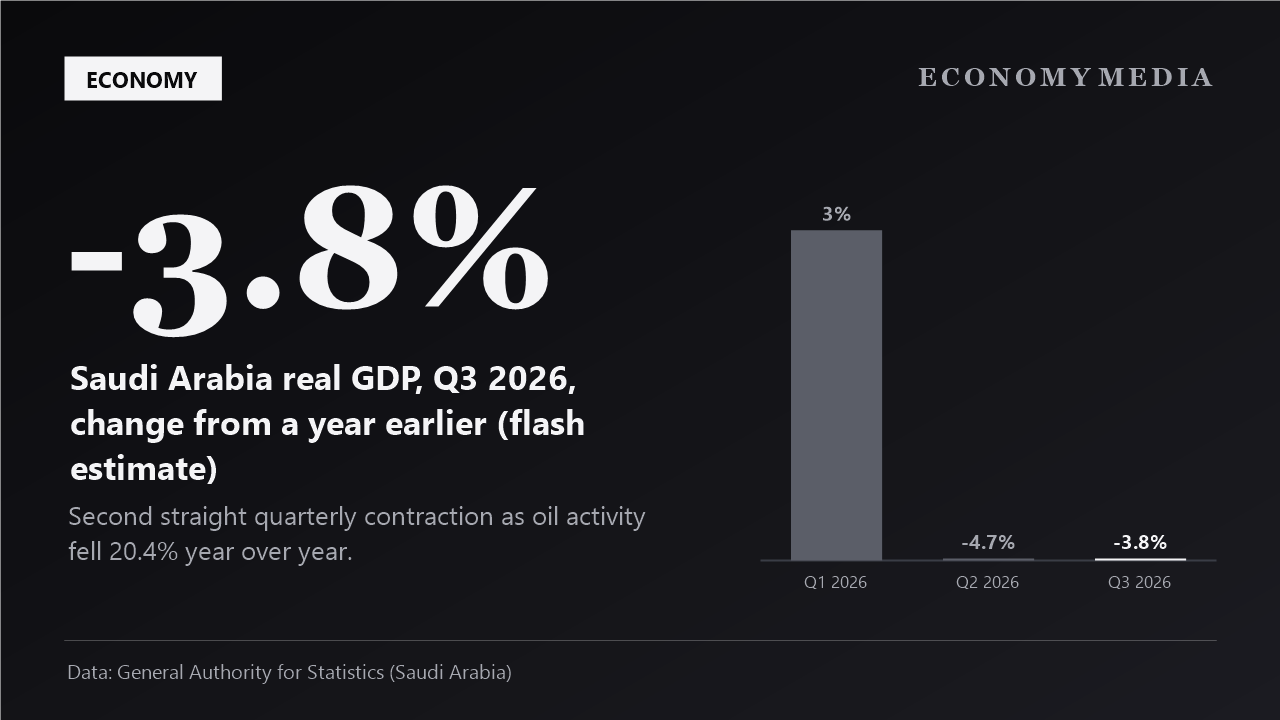
Flash estimates from the General Authority for Statistics, the kingdom’s official statistics agency, show real gross domestic product fell 3.8% in the third quarter of 2026 from a year earlier, according to Trading Economics and the pan-Arab newspaper Asharq Al-Awsat. That followed a 4.7% decline in the second quarter. Oil activity was the main drag, falling 20.4% year over year after a 24.8% slump in the previous quarter.
There were some signs of stabilization. On a seasonally adjusted basis, the economy grew 1.3% from the second quarter, recovering from a 4.8% quarterly drop. Non-oil activity rose 1.9% from a year earlier. Asharq Al-Awsat put second-quarter non-oil growth at 0.9%, while Trading Economics gave 0.8%. Government activities shrank 2.7%, according to Trading Economics.
Asharq Al-Awsat broke the decline down by sector: oil subtracted about 4.7 percentage points from annual growth and government activity about 0.4 points, while the non-oil economy added roughly 1.1 points.
Why the economy is under strain
The sources describe the damage in different ways. Trading Economics attributed the oil slump to the ongoing Middle East conflict, which disrupted shipping through the Strait of Hormuz, the narrow waterway that carries much of the Gulf’s oil exports. Asharq Al-Awsat also pointed to the temporary shutdown in September of the East-West Pipeline, which carries crude across the kingdom to Red Sea ports.
CNBC reported that attacks by Yemen’s Houthi movement have hit civilian and economic infrastructure, including Riyadh’s airport, a tower belonging to the Public Investment Fund (PIF), the sovereign wealth fund that bankrolls much of Vision 2030, and the country’s largest oil refinery. The network noted that responsibility for some of the claimed energy strikes has not been precisely established. Neil Quilliam, managing director of the consultancy Azure Strategy, told CNBC the group had shown it could hit important economic targets and “expose weaknesses in Saudi air defences.”
“The human cost of crisis has been real, and so has been the economic cost,” Alibrahim said. He told CNBC that energy production had been restored to near pre-crisis levels and that the airport’s cargo hub had been moved west and supplied by road, bringing cargo volumes back.
A leaner Vision 2030
Launched in 2016, Vision 2030 has funded giant construction projects alongside efforts to build tourism, mining, logistics and technology industries. Several flagship projects have been scaled back or put on hold, according to CNBC:
- Neom, the planned megacity in the northwest, and its linear city The Line are being reassessed for cost and commercial prospects.
- Construction of the Mukaab, a giant skyscraper planned for Riyadh, has been halted.
- The 2029 Asian Winter Games, which were due to be held at Neom’s Trojena mountain resort, were postponed in January.
- The PIF has stopped funding LIV Golf, the breakaway professional golf tour, and the Future Investment Initiative conference known as “Davos in the Desert” was pushed to 2027.
The pullback did not start with the war. Fortune reported in June that Riyadh was projecting a budget deficit of about $44 billion for 2026 and that the PIF was replacing foreign executives with local hires. Mohammed Al-Jadaan, the finance minister, said late last year that the kingdom would defer or cancel projects that fail to deliver value “without blinking,” Fortune reported.
Akanksha Samdani, lead economist at the research firm Oxford Economics, told CNBC the government is shifting spending toward essential services and strategic priorities, while the PIF “is becoming more selective in its capital allocation and seeking greater private-sector participation.” She said her firm already assumes some Vision 2030 targets will be reached later than planned, but that the broader goal of diversifying the economy is unchanged.
What comes next
Forecasts for the full year vary. CNBC reported that the finance ministry expects the economy to shrink about 2.1% this year before rebounding 10.9% next year, while Oxford Economics projects a 3.4% contraction in 2026. Asharq Al-Awsat cited government estimates of a 3.6% contraction this year, with the budget deficit widening to 4.9% of GDP, and said the International Monetary Fund projects 7.9% growth in 2027.
To attract private investment, the kingdom is introducing a 15% minimum effective tax rate on the profits of multinational companies. Alibrahim said it would “create a clearer environment for the private sector to operate.” Asharq Al-Awsat noted that the non-oil sector now makes up 57.3% of the economy and that Saudi unemployment has fallen to 6.5%, figures officials point to as evidence that diversification is helping the economy absorb the shock. How quickly oil exports recover will depend largely on security in the Gulf and the Red Sea.