Tencent Misses Revenue Estimates as AI Spending Surges
Tencent's third-quarter revenue rose 8% but missed forecasts, while adjusted profit fell and capital spending on AI climbed sharply.
Tencent Holdings, the Chinese internet and gaming giant behind the WeChat messaging app, reported third-quarter revenue that fell short of analyst estimates on Wednesday, as a surge in spending on artificial intelligence weighed on its adjusted profit.
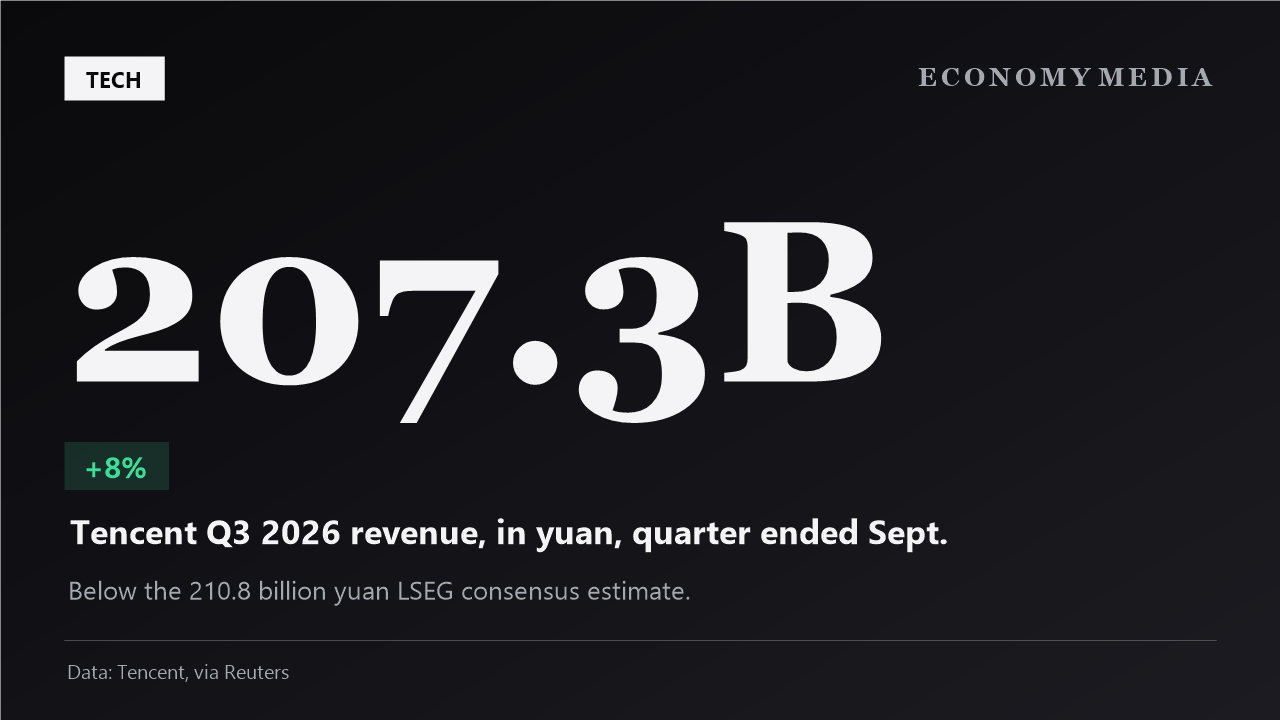
Revenue for the quarter ended September rose 8% from a year earlier to about 207.3 billion yuan (roughly $31.1 billion), Reuters reported. That was below the 210.8 billion yuan average forecast compiled by LSEG, a financial data provider, and slower than the 11% growth Tencent posted in the previous quarter.
What happened
Reported net profit rose 0.8% to 63.61 billion yuan, ahead of the 59.46 billion yuan analysts had expected, according to Reuters and Hong Kong’s The Standard. But adjusted net profit, which strips out certain items, fell 5.7% to 66.5 billion yuan, The Standard reported.
Capital expenditure, the money a company spends on equipment and infrastructure such as data centers and chips, reached 81.4 billion yuan in the quarter, Reuters said. That compares with 52.8 billion yuan in the second quarter. Reuters noted that first-half capex of 84.7 billion yuan was already larger than the roughly 79 billion yuan Tencent spent in all of 2025.
Free cash flow, the cash left after capital spending, was negative 69.1 billion yuan, The Standard reported, the second straight negative quarter. The newspaper said that figure reflects large prepayments for computing capacity. Excluding those prepayments, free cash flow would have been positive 16.9 billion yuan, it said.
Bloomberg, in its coverage, framed the results as a setback for the AI push led by Tencent’s founder, saying aggressive AI spending has begun to stall profit growth. Reports differed on how to measure operating profit, depending on whether adjusted or unadjusted figures were used, so that figure is not detailed here.
Where growth came from
Gaming, Tencent’s traditional engine, cooled. Reuters said value-added services, which include games and social networks, rose 3% to 98.3 billion yuan. Domestic games grew 11%, while international games fell 9%, according to The Standard.
Cloud services were a bright spot. The Standard reported cloud revenue rose 35%, driven by AI-related demand and international expansion. Marketing services revenue, which is advertising, rose 19% to 43 billion yuan, the paper said. Fintech and business services revenue rose 9% to 63.7 billion yuan.
The company said its WorkBuddy AI agent is China’s most used AI product by large language model token consumption, with more than 10 million daily active users, according to The Standard. Reuters quoted Ma Huateng, Tencent’s chairman and chief executive, as citing “substantial progress towards building a new, AI-empowered Tencent.”
Why it matters
The results put a spotlight on a question facing many large technology companies: whether heavy AI investment will pay off or mainly squeeze margins. Reuters said that question is central for Tencent investors.
Regulation adds uncertainty. Reuters reported that new US rules restricting remote access to advanced AI chips through overseas data centers pushed shares of Chinese cloud companies, including Tencent, lower on Tuesday. Tencent said a year ago that chip shortages were limiting cloud growth because it prioritized its own use of AI chips over renting out computing power.
What comes next
It is not yet clear how much of the capex surge will continue in coming quarters, and the articles reviewed did not detail forward guidance. Investors will likely watch whether cloud and advertising growth can offset the heavier spending and slower gaming revenue.