Tidal to Delete 29 Million AI-Generated Songs in Outright Ban
Tidal will start removing wholly AI-generated tracks on Dec. 9, deleting about 29 million songs, after labels and lost royalties failed to stem the flood.
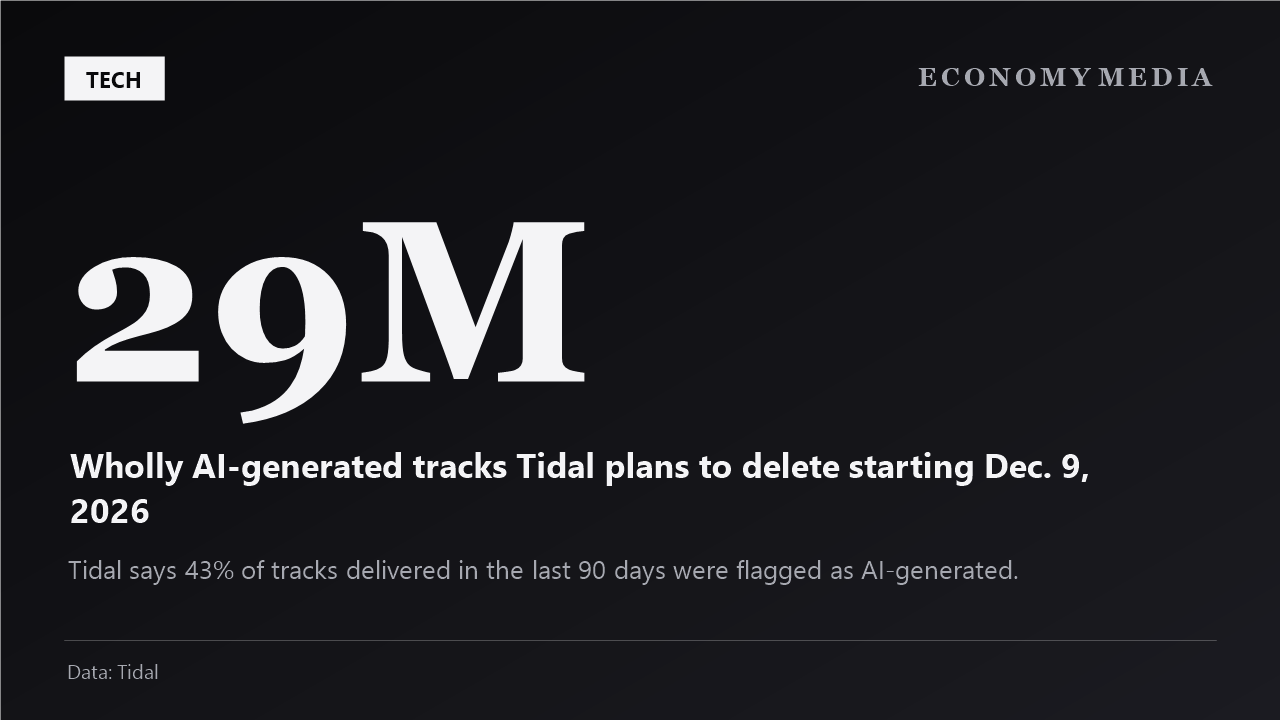
Tidal, the music streaming service owned by Jack Dorsey’s payments company Block, said Tuesday it will begin removing all wholly AI-generated songs from its catalog on December 9, a move expected to wipe out roughly 29 million tracks. The company says it is the first major streaming platform to ban fully machine-made music outright rather than simply labeling it or cutting its royalties.
The announcement came from Robert Andersen, who leads Tidal at Block, in a post on X, and Tidal’s own account confirmed the date, according to The Next Web. Engadget reported that the service also expects to turn away 80,000 to 85,000 newly submitted songs every day once the rule takes effect.
What Tidal is changing
The ban targets tracks made entirely by artificial intelligence, which Tidal identifies with automated detection tools. Songs where artists used AI tools as part of their process will still be allowed, according to Newsweek and The Next Web. Newsweek reported that distributors, the companies that deliver music from artists and labels to streaming services, will also be barred from sending fully AI-generated tracks to the platform.
Andersen said the purge should be finished around the start of 2027, with AI-generated music “completely gone by the new year,” as Newsweek quoted him. He urged other streaming services to follow Tidal’s lead.
The Next Web noted that Tidal’s terms of service acknowledge its detection tools can wrongly tag tracks, and that users can ask the company’s support team to correct a label. None of the reports described a formal appeals process for artists whose songs are removed.
Why Tidal says labels were not enough
The ban is a sharp escalation from the approach Tidal adopted earlier this year, when it began tagging songs as AI-generated and stopped paying royalties on tracks made wholly by AI. At the time, the company said it would still host such music.
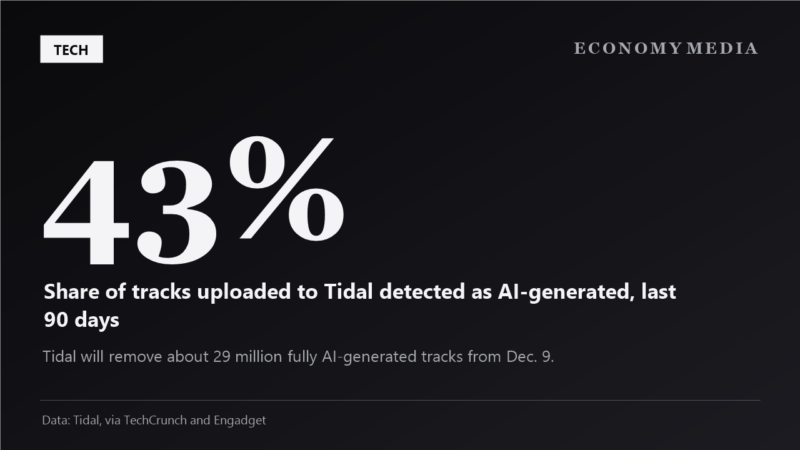
Andersen said that policy failed to slow the flood. In his post, he wrote that 43% of tracks distributed to Tidal in the last 90 days had been detected as AI-generated, adding that “something more drastic needs to be done.” Newsweek reported that the company saw its largest single influx on November 6, when more than 60% of deliveries were AI-generated.
Andersen also argued that listeners are not missing much. According to Engadget, he said 96% of all AI-generated songs on the service receive zero plays, and that he expects the decision to resonate with both artists and listeners.
Key figures Tidal has cited:
- About 29 million wholly AI-generated tracks to be deleted starting December 9
- 80,000 to 85,000 AI tracks expected to be rejected each day after the change
- 43% of tracks delivered in the last 90 days flagged as AI-generated
- 96% of AI-generated songs on the platform never played
- More than 65,000 tracks taken down over suspected impersonation of real artists, per Newsweek
Tidal has described AI music that imitates real artists as “a serious problem that has only increased in scale,” Newsweek reported.
How rivals are handling AI music
Tidal’s stance sets it apart from larger competitors, most of which have chosen to label or filter AI music rather than remove it. Engadget noted that Bandcamp, the independent music marketplace, is the only other platform to have banned music generated wholly or in substantial part by AI, a policy it announced in January.
Spotify, the world’s largest streaming service, has focused on spam. According to Newsweek, Spotify removed more than 50 million spam tracks from its recommendations in October, and it labels AI music and permits AI voice clones only with the imitated artist’s permission. The Next Web described those spam tracks as pulled from recommendations but left on the service. Engadget reported that Spotify has also said it will let people remix and cover songs using AI.
Apple Music has introduced transparency tags that disclose AI use in music, lyrics or artwork, while Deezer, the French streaming service, labels AI music and keeps it out of recommendations and lets listeners hide it, according to the reports. SoundCloud has partnered with AI music companies including ElevenLabs while trying to weed out spam, Engadget said.
Background and what comes next
Tidal was launched in 2010 and was later bought by rapper and businessman Jay-Z, who marketed it as an artist-friendly alternative to bigger services. Block, the company behind Square and Cash App, became its majority owner in 2021 in a deal worth nearly $300 million, Newsweek reported.
The ban arrives with some irony. Engadget pointed out that Dorsey, Block’s co-founder and chief executive, is an outspoken AI enthusiast who earlier this year cut about 4,000 of Block’s roughly 10,000 jobs, a reduction he attributed to AI tools changing how companies are run.
The policy will be watched closely by artists and rival platforms. Tidal is far smaller than Spotify or Apple Music, so its decision alone will not stop the spread of AI-generated tracks across the industry. But if its detection holds up and listeners respond well, it could add pressure on bigger services to go further than labels. The main open questions are how accurately Tidal’s tools separate fully AI-made songs from AI-assisted work, and how quickly mistakes affecting human artists can be fixed.