UK Services Growth Hits 8-Month High as Bank of England Eyes Hike
Britain's services sector grew at its fastest pace since February in October, strengthening expectations of a Bank of England rate rise on Thursday.
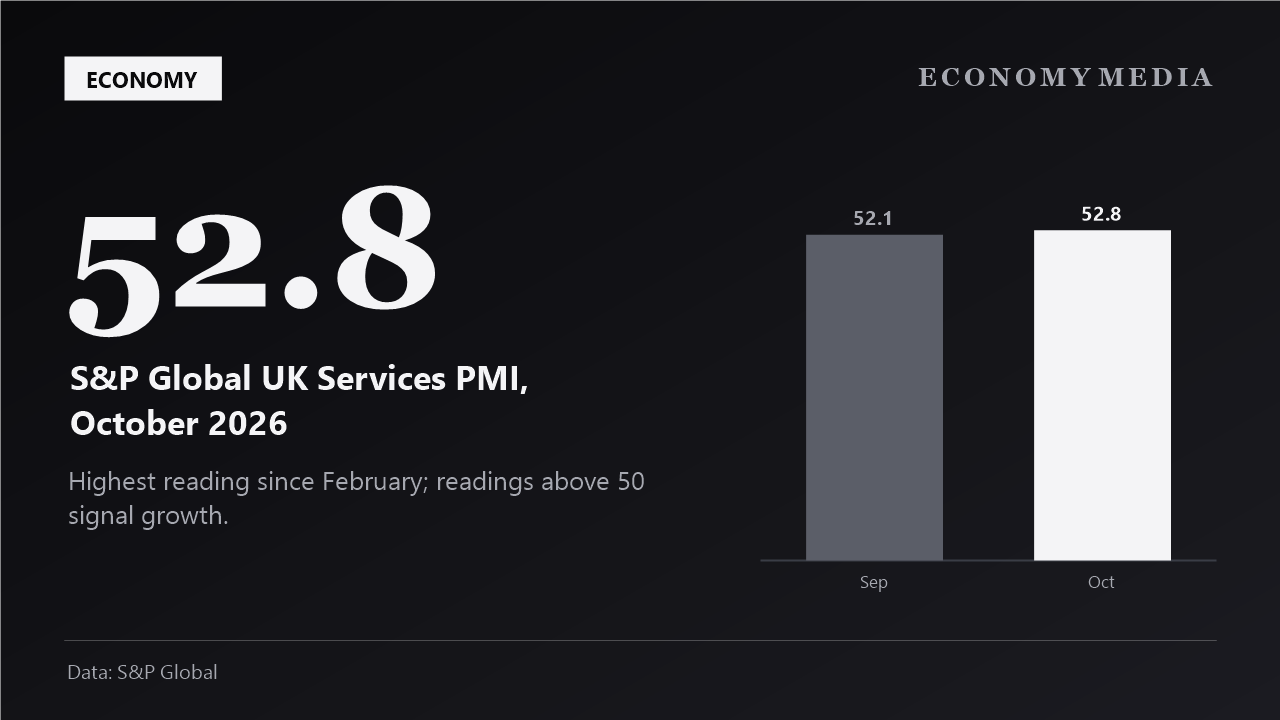
Britain’s dominant services sector expanded at its fastest pace in eight months in October, helped by business spending on artificial intelligence, and firms began adding staff again for the first time in more than two years. The S&P Global UK Services Purchasing Managers’ Index (PMI) rose to 52.8 from 52.1 in September, Reuters reported on Wednesday, a reading that adds to pressure on the Bank of England to raise interest rates when it announces its decision on Thursday, Nov. 5.
What the survey showed
The PMI is a monthly survey of company purchasing managers compiled by S&P Global, a financial data and ratings firm. Readings above 50 indicate that activity is growing, while readings below 50 point to contraction. October’s final figure was slightly below the preliminary “flash” estimate of 53.1 published last month, but it was still the strongest result since February, when the war involving Iran began and pushed up energy costs around the world.
The broader composite PMI, which combines services with manufacturing, climbed to 52.9 from 52.0, also its highest level since February, according to Reuters.
Tim Moore, economics director at S&P Global Market Intelligence, linked the rise in workloads to an “improved pipeline of sales opportunities,” especially those connected to AI investment. He said the survey pointed to “increasing economic resilience despite challenges from geopolitical tensions,” according to Brit Brief, a UK news site.
Other details from the report included:
- The employment gauge rose by 2 points and moved above 50, the first time it has signaled job growth since September 2024, Reuters reported.
- Input costs rose at their fastest pace since May, driven by energy, fuel, transport, wages and raw materials, according to Brit Brief.
- The prices that service companies charge their customers rose slightly less quickly than in September.
- Businesses’ expectations for future activity reached their highest level since February.
The hiring recovery was modest. Moore said “the pace of job creation was only marginal” as companies kept a close eye on costs, Brit Brief reported.
Why it matters for interest rates
The data come a day before the Bank of England’s Monetary Policy Committee, the nine-member panel that sets UK borrowing costs, announces its latest decision. Economists polled by Reuters expect the Bank to raise its key rate to 4% from 3.75%, which would be its first increase since August 2023. S&P Global said the survey suggested a rate rise on Thursday was likely, according to Reuters.
The main driver is inflation. Consumer prices rose 3.5% in the 12 months to September, well above the 3.0% the Bank had forecast in July, and in September the Bank warned that inflation could climb above 4% early next year, Reuters reported. High energy prices linked to the Iran war have fed into costs for households and businesses alike.
The Reuters poll points to a 7-2 vote in favor of a hike, with Alan Taylor and Swati Dhingra, two external committee members, seen as the most likely to prefer holding rates steady. In September, the committee voted 6-3 to leave rates unchanged.
Stefan Koopman, a senior macro strategist at Dutch bank Rabobank, told Reuters that policymakers’ “hands are increasingly being forced, whether they like it or not.”
What comes next
The bigger question for borrowers is what happens after Thursday. Financial markets are pricing in three to four more quarter-point increases in 2027, which would lift the Bank Rate to between 4.75% and 5%, according to Reuters. Some economists doubt the Bank will go that far. Alexander Harvey, a UK economist at research firm Oxford Economics, told Reuters that the rate is “unlikely to reach the level that is priced in by financial markets,” and the Bank may push back against expectations of a long series of hikes.
For households, higher Bank Rate typically feeds through to more expensive mortgages and loans, along with better returns on savings. Andrew Bailey, governor of the Bank of England, has said businesses appear to be absorbing more of their higher costs than they did during the 2022 inflation surge, Reuters reported, a factor that could limit how far rates need to rise.
Not every part of the economy is sharing in the services rebound. Brit Brief reported that official estimates show much of the recent strength has come from IT and professional services. Matt Swannell, chief economic adviser to the EY Item Club, a forecasting group, warned of “a two-speed economy” in which consumer-facing services come under increasing pressure.