US Retail Sales Growth Slows to Weakest Pace in Nearly a Year
Retail spending rose just 0.2% in October, the smallest gain since November 2025, as high prices weigh on household budgets, the CNBC/NRF Retail Monitor shows.
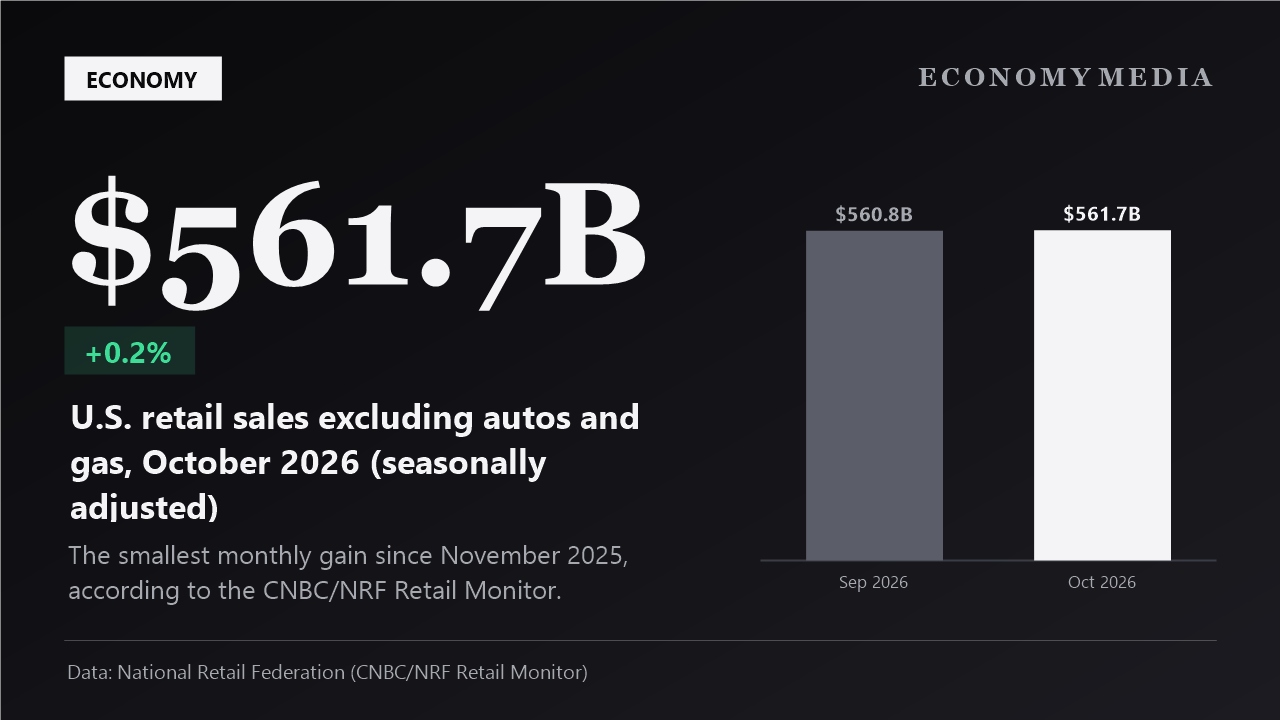
American shoppers kept spending in October, but at the slowest pace in nearly a year, according to the CNBC/NRF Retail Monitor released Wednesday. The data adds to signs that high prices are straining household budgets ahead of the holiday shopping season.
The monitor, which the National Retail Federation (NRF), the largest U.S. retail trade group, publishes with CNBC, showed total retail sales of $561.7 billion in October. That was up 0.2% from September after seasonal adjustment and up 3.6% from a year earlier. The total leaves out spending at auto dealers and gas stations. CNBC reported that the monthly gain was the weakest since November 2025.
What the numbers show
Core retail sales, which also leave out restaurants and are watched as a cleaner read on everyday spending, rose 0.3% from September to $454.2 billion. They were up 3.4% from October 2025, according to the NRF’s release. More precise figures in that release show total sales up 0.15% for the month and core sales up 0.26%.
Both measures cooled from September. Total sales grew 0.28% month over month and 4.05% year over year in September. Core sales grew 0.27% and 3.73%. Over the first 10 months of 2026, total sales were up 5.75% from the same period a year earlier and core sales were up 5.63%, the trade group said.
Where shoppers spent, and where they pulled back
Spending rose from a year earlier in nine of the 11 retail categories the monitor tracks, CNBC reported. Electronics and appliances posted the biggest annual gain, up 9.3%. CNBC noted that technology companies have raised prices on products ranging from MacBooks to Xbox consoles as the artificial intelligence boom pushes up the cost of memory chips. Part of that gain may therefore reflect higher prices rather than more items sold.
Two categories fell:
- Furniture and home furnishings slipped 0.2% from September and were down 2.6% from a year earlier. CNBC linked the weakness to a frozen housing market as mortgage rates have climbed. Fewer home sales usually mean fewer purchases of sofas, beds and appliances for new homes.
- Sporting goods, music and bookstores, a group CNBC calls the leisure basket, were down about 0.4% from a year earlier, though sales improved from September.
Why it matters for households
Consumer spending makes up the largest share of U.S. economic activity, so a slowdown at the register is closely watched as a sign of how families are coping with prices. Matthew Shay, president and chief executive of the NRF, said households are budgeting carefully and timing purchases around special offers and sales to stretch their dollars. He added that retailers are leaning on promotions and value pricing to keep everyday goods and holiday gifts affordable.
The NRF also offered a more upbeat reading. In its release, Shay said sales “edged higher in October as a strong Halloween season and early winter holiday promotions pulled demand forward.” CNBC reported that those same factors kept the monthly figure from being even weaker. That raises the possibility that some holiday spending happened earlier than usual instead of adding to the season’s total.
The retail figures came a day after the Bureau of Labor Statistics reported that the consumer price index, the government’s main inflation gauge, rose 0.4% in October, slightly above economists’ forecasts. Because retail sales are measured in dollars and are not adjusted for inflation, rising prices can make spending growth look stronger than the actual volume of goods people are buying. CNBC also pointed to a survey by the National Federation of Independent Business, a small-business group, in which a net 37% of firms said they plan to raise prices over the next three months. That is the highest share since July 2022.
How the monitor works and what comes next
The Retail Monitor is built from anonymized transaction data from Affinity Solutions, a consumer purchase data company. It covers about 120 million debit and credit cards and is weighted to match the makeup of the Census Bureau’s official retail sales totals. October was the first full month under a revised method that adds dollar sales levels. The NRF has cautioned that changes calculated under the new method are not directly comparable with figures published before September 2026.
The data arrives as retailers head into the November and December shopping period, their most important stretch of the year. Inflation and the cost of living were key issues for voters in last week’s midterm elections, CNBC noted. How shoppers balance high prices against holiday spending will be a closely watched test of the economy in the weeks ahead.