Bank of England’s Pill Signals More Rate Hikes as UK Inflation Climbs
Bank of England chief economist Huw Pill says rates will likely rise again in December and early 2027 as energy-driven inflation climbs.
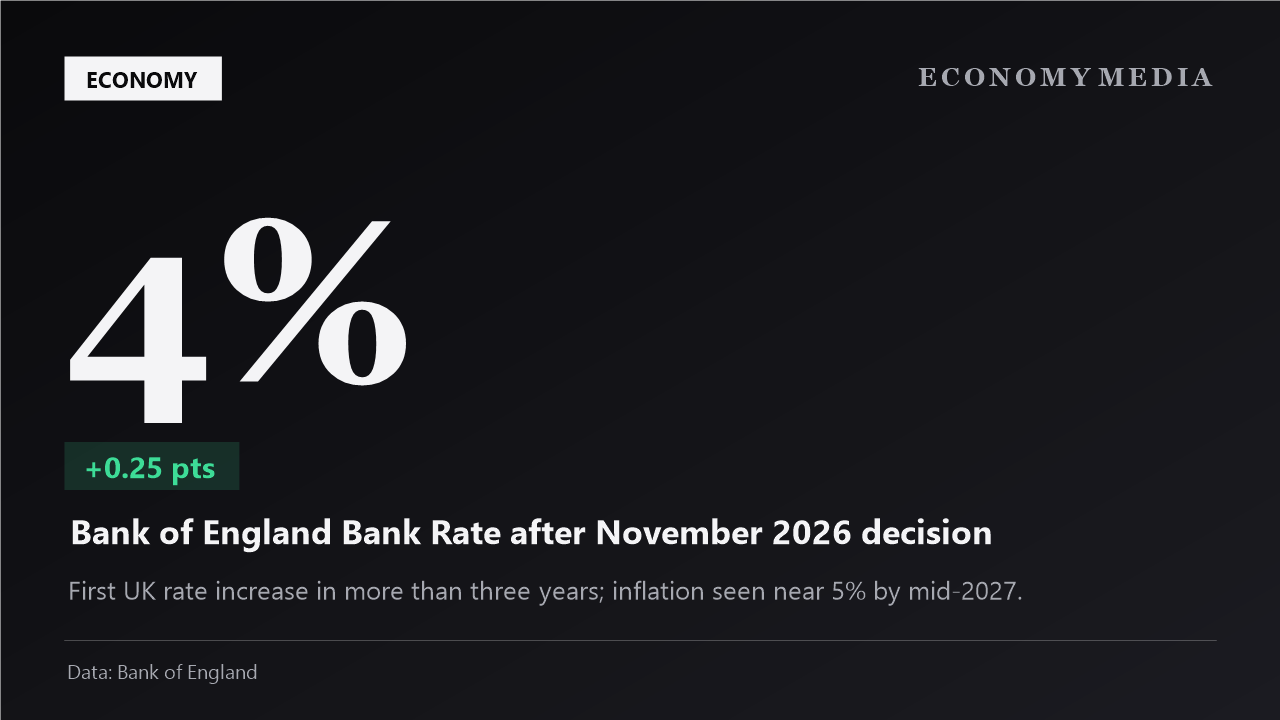
The Bank of England will probably need to raise interest rates again next month and once more in early 2027 to contain rising inflation, its chief economist, Huw Pill, has said. The comments, reported by the Guardian on Saturday, come less than two weeks after the central bank lifted its benchmark rate for the first time in more than three years. They point to higher borrowing costs for millions of British households.
“We have further to go,” Pill told the Guardian. He signaled that this month’s quarter-point increase, which took Bank Rate from 3.75% to 4%, was unlikely to be enough on its own to bring inflation back under control.
What happened
The Monetary Policy Committee (MPC), the nine-member panel that sets UK interest rates, voted 8-1 at its meeting ending Nov. 4 to raise Bank Rate by 0.25 percentage point to 4%, according to the Bank’s November Monetary Policy Report. The one dissenting member wanted a larger half-point increase, to 4.25%. Some early market coverage misreported the decision as unanimous; the Bank’s own report gives the 8-1 split.
The Bank said consumer price inflation reached 3.5% in September, up from 2.6% in June. It expects inflation to climb to around 5% in the second quarter of 2027, driven mainly by higher global energy prices linked to the conflict in the Middle East, before easing back toward its 2% target. The MPC said monetary policy “is not on a pre-set path” and that it would adjust rates as needed to bring inflation back to target over the medium term.
Pill, who also sits on the MPC, has been among the committee’s more hawkish voices, meaning he leans toward tighter policy to fight inflation. The financial news site investingLive, summarizing the meeting’s minutes, reported that Pill and Deputy Governor Clare Lombardelli saw a case for further near-term increases, with Pill suggesting a single quarter-point move might not be sufficient.
Why it matters for households
Higher Bank Rate feeds through to mortgage costs, especially for borrowers coming off cheaper fixed-rate deals. The Guardian estimated that about 2.3 million homeowners will need to refinance their loans next year, many of whom could face sharply higher monthly payments if rates keep rising.
The central bank’s concern is so-called second-round effects, in which an initial jump in energy costs spreads into wages and the prices of other goods and services, making inflation more persistent. The MPC said those effects have been “somewhat limited” so far, according to a Press Association report published by Nation.Cymru, but it is watching pay settlements and shop prices closely.
- Bank Rate: 4%, up from 3.75%
- Latest inflation: 3.5% in September
- Projected peak: about 5% in mid-2027
- Inflation target: 2%
Mixed signals from the Bank
Pill’s latest remarks sound firmer than some of his earlier comments. Speaking on Nov. 6, the day after the decision, he described the increase as pre-emptive and said the Bank was “not going to repeat” its 2022 tightening cycle, according to investingLive. In that year the Bank raised rates eight times in a row, the Press Association noted. Pill said then that the energy shock is smaller than in 2022, particularly for gas prices, and that rates could even stay on hold or fall next year if economic growth stalled.
Governor Andrew Bailey has also struck a cautious tone. He said the November increase “shouldn’t be seen as the first in an inevitable long sequence of hikes,” though he added it was unlikely to be the last unless the Middle East conflict is resolved, the Press Association reported. According to investingLive’s account of the minutes, Bailey argued that part of the recent rise in market interest rates reflects higher risk premiums rather than expectations of more tightening.
Other members appeared split. The minutes, as summarized by investingLive, showed some policymakers viewing the hike mainly as insurance against a worse inflation outcome, while others expected more increases to follow.
What comes next
Investors had already been betting on further tightening. After the November decision, markets priced roughly a 50% chance of another increase in December and about 0.68 percentage point of total tightening by the end of 2027, investingLive reported. Pill has said financial markets expect three more increases, according to the Press Association.
Pill has also said the key evidence on whether rates need to keep climbing will arrive in spring 2027, as annual pay negotiations conclude and companies decide how much of their higher costs to pass on to customers. He has stressed that the risks run in both directions: inflation could prove stickier than expected, or weaker growth could ease price pressures on its own.
The MPC’s next rate decision is due in December. Its path from there will depend heavily on energy prices, developments in the Middle East and incoming data on wages and consumer prices.