IRS Raises 2027 401(k) Limit to $25,500; IRA Cap Stays at $7,500
Workers can put $1,000 more into 401(k) plans in 2027, the IRS said, while the IRA contribution limit stays at $7,500 for a second year.
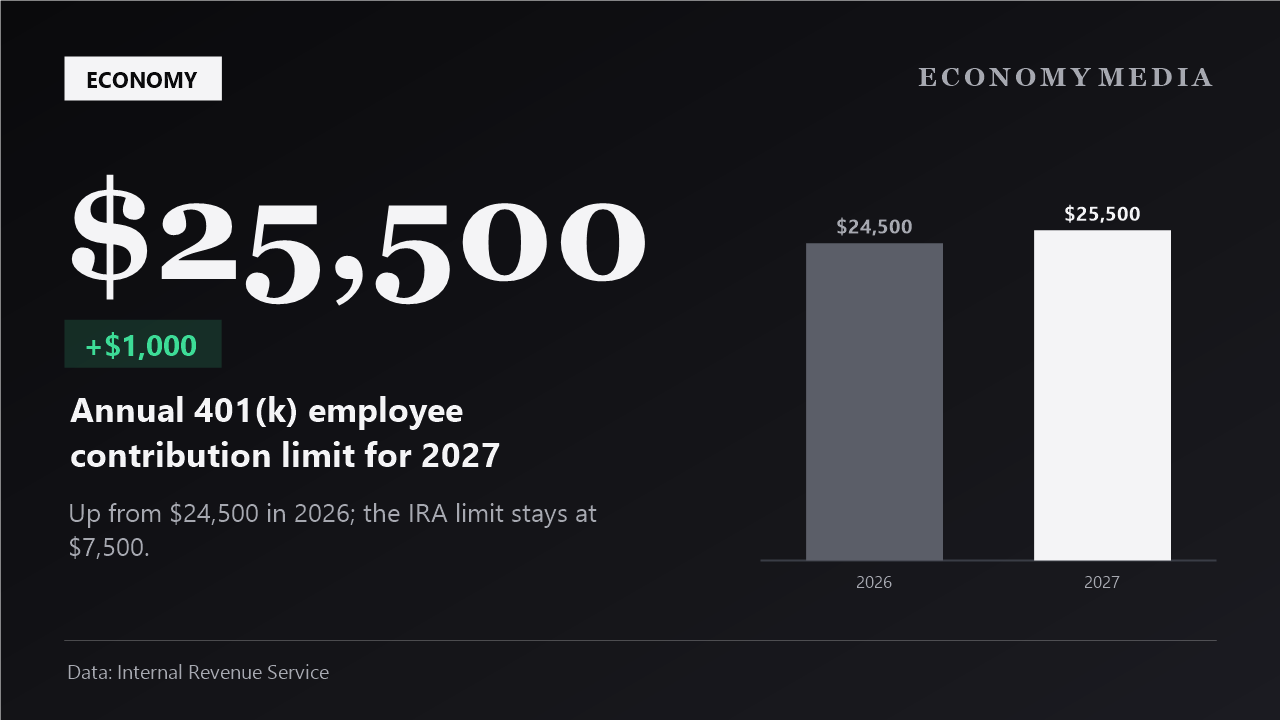
Americans with workplace retirement plans will be able to set aside $1,000 more next year. The Internal Revenue Service said on Thursday, Nov. 12, that the annual contribution limit for 401(k), 403(b), governmental 457 plans and the federal Thrift Savings Plan will rise to $25,500 in 2027, up from $24,500 in 2026. Savers who use individual retirement accounts get no increase: the IRA limit stays at $7,500.
The IRS announced the new figures in a news release and in Notice 2026-66, the technical document that sets out the cost-of-living adjustments for retirement plans. Local broadcaster WBAL-TV and the real estate and finance outlet HousingWire reported the same core numbers, and none of the coverage reviewed for this article disagreed on them.
What changes in 2027
The IRS adjusts these limits each year to account for changes in the cost of living. Workers 50 and older get extra room on top of the standard cap through what are known as catch-up contributions. According to the IRS release, the key 2027 figures are:
- Workplace plans: $25,500 for 401(k), 403(b), governmental 457 plans and the Thrift Savings Plan, up from $24,500.
- Catch-up, age 50 and older: $8,500, up from $8,000, which brings the total possible employee contribution for these workers to $34,000.
- Catch-up, ages 60 to 63: $11,750 in place of the regular catch-up, for a total of $37,250, as WBAL-TV and HousingWire calculated.
- SIMPLE plans: $17,500, up from $17,000. SIMPLE plans are retirement plans offered by small employers.
- IRAs: $7,500, unchanged, with the IRA catch-up for people 50 and older also unchanged at $1,100.
HousingWire noted that the larger catch-up for people ages 60 to 63 comes from the SECURE 2.0 Act of 2022, a federal retirement law that created the higher tier for workers approaching retirement. Milliman, an actuarial and consulting firm, put the 2026 version of that limit at $11,250, which means the 2027 figure rises by $500.
Why it matters for households
Higher limits let workers who already contribute the maximum shelter more of their pay in tax-advantaged accounts. Savers who contribute less than the cap are not directly affected by the higher ceiling. The adjustment also helps employers and payroll providers update their systems before the new year.
The IRS also raised the income ranges that determine who can deduct contributions to a traditional IRA or contribute to a Roth IRA, a type of account funded with after-tax money. For single filers covered by a workplace plan, the traditional IRA deduction now phases out between $83,000 and $93,000 of income, up from $81,000 to $91,000. The Roth IRA phase-out range for single filers and heads of household rises to between $158,000 and $173,000, up from $153,000 to $168,000. For married couples filing jointly, the Roth range moves to $250,000 to $260,000.
Income limits for the Saver’s Credit, a tax credit aimed at low- and moderate-income savers, also rise. For married couples filing jointly the limit goes to $83,000 from $80,500, according to the IRS.
Frank J. Bisignano, the IRS chief executive, tied the change to the administration’s broader tax agenda, saying in the release that the higher limits, together with what the administration calls the Working Families Tax Cuts, “will help American families.”
Why the IRA limit did not move
The IRS did not explain in its release why the IRA cap stayed flat, saying only that the limit “remains $7,500.” The workplace plan limits and the IRA limit are adjusted separately, so a rise in one does not mean the other will move in the same year.
The 401(k) increase was largely expected. In an Oct. 15 forecast, Milliman projected the $25,500 limit and the $8,500 catch-up. The firm said the adjustment is based on the Bureau of Labor Statistics’ consumer price index for the 12 months ended Sept. 30, which rose 3.7% over that period. Milliman estimated the resulting increase factor for 2027 limits at about 3.5%.
What comes next
The new limits take effect on Jan. 1, 2027. The IRS says the annual adjustments are published early so taxpayers and employers can plan for the coming year. The full set of figures, including limits that affect higher earners and plan sponsors, is in Notice 2026-66 on the IRS website.