Chip Exports Overtake Oil and Gas for First Time, Deutsche Bank Says
Global semiconductor exports topped oil and gas in 2026, Deutsche Bank research shows, as the AI boom reshapes trade and dollar flows.
Semiconductors have overtaken oil and gas as the world’s most valuable traded commodity group for the first time in modern history, according to Deutsche Bank research. The finding comes as investors weigh how lasting the artificial intelligence boom will be after a severe sell-off in chip stocks last week.
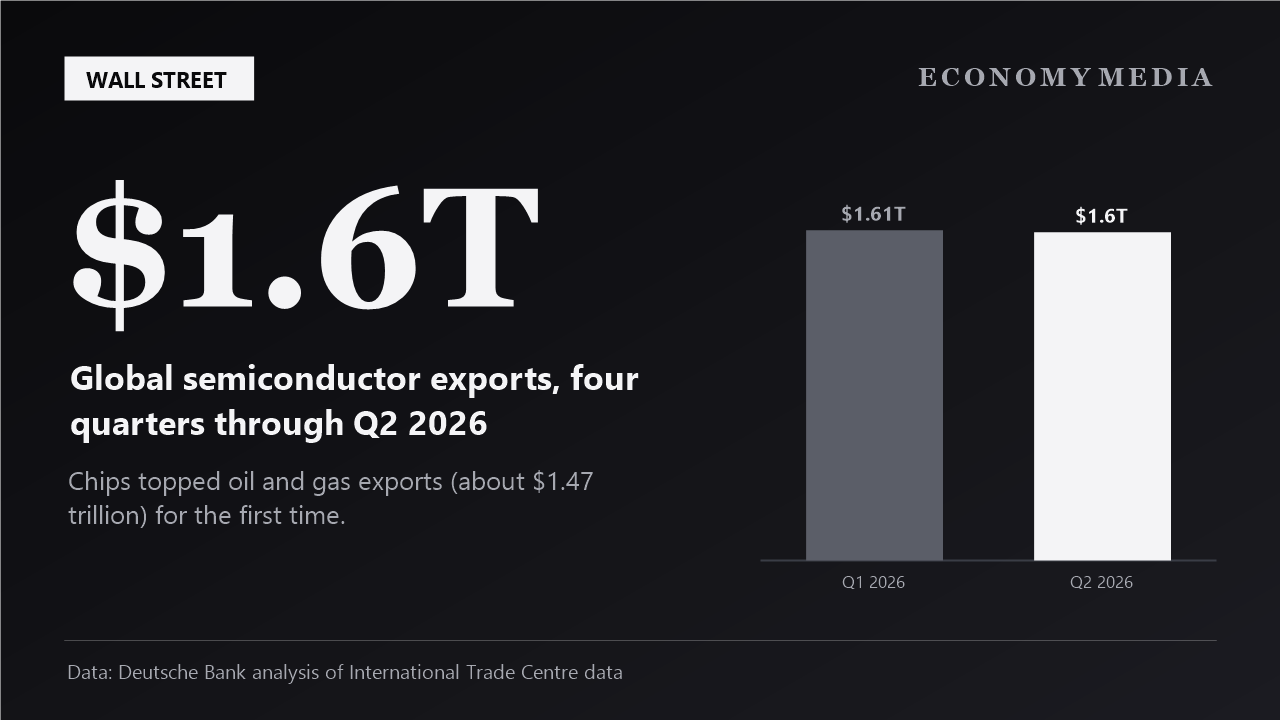
CNBC reported on Thursday that semiconductor exports totaled about $1.61 trillion in the four quarters through March 2026, compared with $1.53 trillion for oil and gas. Deutsche Bank’s analysis used figures from the International Trade Centre, a joint agency of the United Nations and the World Trade Organization. In the four quarters through June, chips held the lead at about $1.60 trillion, against roughly $1.47 trillion for oil and gas.
What the numbers show
The data are four-quarter rolling totals. The first quarter of 2026 was the first period in which chips moved ahead, and the gap widened in the second quarter as energy trade shrank.
Part of the shift reflects turmoil in energy markets. According to the U.S. Energy Information Administration, daily oil flows through the Strait of Hormuz fell nearly 77%, from 21.6 million barrels in the fourth quarter of 2025 to 4.9 million barrels in the second quarter of 2026, a disruption CNBC tied to the Iran war. The comparison therefore reflects weaker energy trade as well as rising chip sales.
From petrodollar to ‘chip dollar’
Deutsche Bank argues the change could alter how trade surpluses move through the global financial system. For about half a century, Gulf oil producers sold crude in dollars and recycled much of the proceeds into U.S. Treasury securities, a system known as the petrodollar.
Jim Reid, Deutsche Bank’s global head of macro and thematic research, wrote this month that “perhaps increasingly we need to think about the chip dollar,” CNBC reported. Investing.com and Investinglive attributed a related November 16 note to Mallika Sachdeva, a Deutsche Bank foreign-exchange strategist. That note found that chip surpluses in Asia outside China, including South Korea, Taiwan, Japan and Southeast Asia, now rival the Gulf’s petroleum-related surpluses.
The difference, according to the bank, is where the money goes. Rather than buying Treasuries, Asian investors are increasingly putting chip earnings into U.S. stocks. Highlights from the research, as reported by Investing.com and Investinglive:
- Foreign purchases of U.S. equities topped $1 trillion over the past year, more than double foreign buying of Treasuries.
- South Korea’s semiconductor exports have risen more than 200% from a year earlier, and its chip trade surplus is approaching $250 billion.
- About 70% of Korea’s overseas equity holdings are in U.S. stocks, rising above 90% for households.
- U.S. companies capture about 70% of semiconductor industry profits through their control of chip design, software and manufacturing equipment.
Reid described the outcome as “potentially more growth, more excitement, more volatility, and structurally higher yields,” according to CNBC.
Why it matters for markets
The bank sees a built-in risk. Asian chip surpluses are funding purchases of U.S. AI stocks, but those surpluses exist largely because U.S. technology companies are spending heavily on AI hardware. Investinglive reported that the note warns the foreign bid for U.S. equities could dry up quickly if demand for computing power falls short of the investment. Investing.com reported that the bank sees the dollar becoming more sensitive to tech valuations, noting that U.S. stocks are roughly three times as volatile as Treasuries.
That risk was on display last week. CNBC reported that the PHLX Semiconductor Index, a benchmark of U.S.-listed chip stocks, fell nearly 11% on Friday, ending a weekly drop of more than 17%, its worst week in a quarter century. Nvidia rose more than 31% on Monday after seven straight weekly declines totaling 46%, then lost almost 10% over Tuesday and Wednesday. Micron Technology sank 27% over the seven days through Friday.
What comes next
Deutsche Bank expects demand to keep growing. The research estimates that hyperscalers, the largest cloud computing companies, have committed close to $8 trillion in capital spending through 2031, which could generate about $4 trillion of additional semiconductor demand. Cara Thomson, an analyst at Rothschild & Co Redburn, told CNBC that “compute will be the new commodity fueling this transformation on a global scale.”
Whether chip trade keeps its lead may depend on two things: whether AI spending holds up after the recent sell-off, and whether energy flows through the Middle East recover.