Dow Sinks 1,101 Points as Wall Street Selloff Deepens Over AI Doubts
The Dow closed below 50,000 for the first time since June as the S&P 500 posted a sixth straight loss and more than 90% of its stocks fell.
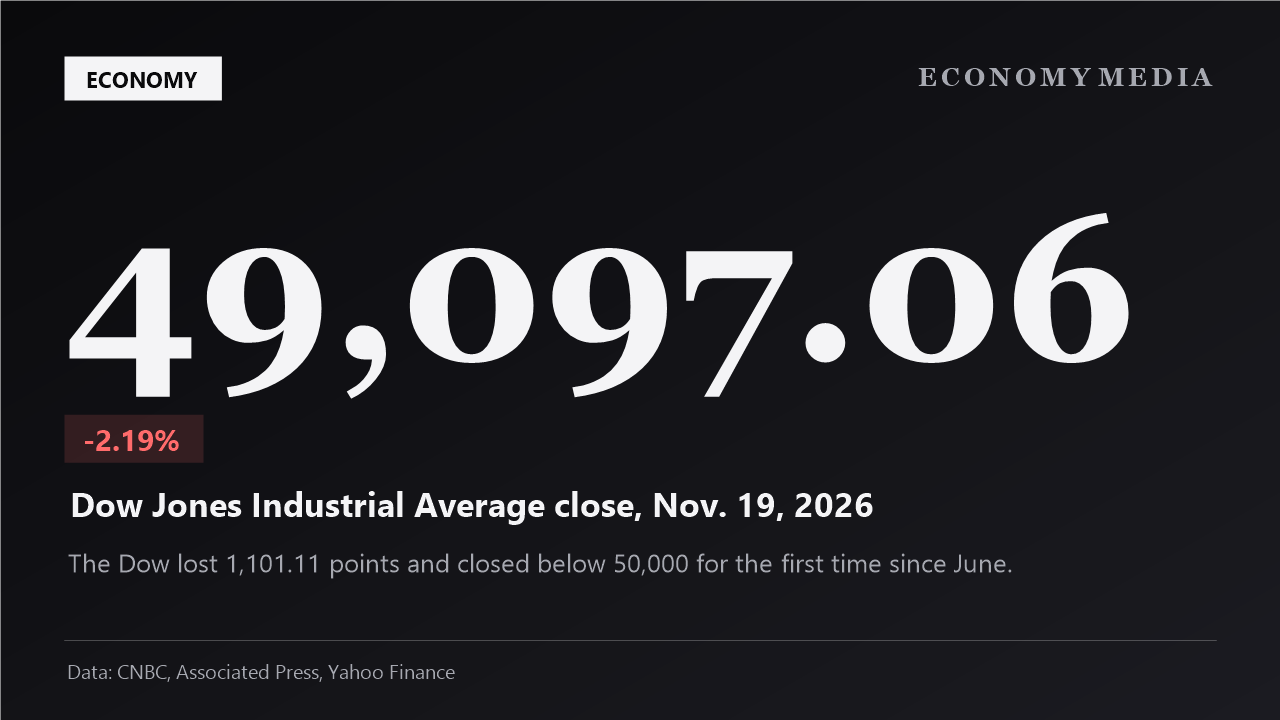
U.S. stocks tumbled on Thursday, Nov. 19, in a broad selloff that pushed the Dow Jones Industrial Average below 50,000 for the first time since June. The Dow fell 1,101.11 points, or 2.19%, to 49,097.06, while the S&P 500 dropped 2.02% to 7,175.83 and the Nasdaq Composite lost 2.25% to 23,879.20, according to closing figures reported by CNBC, the Associated Press and Yahoo Finance. The slide came even as artificial intelligence developer Anthropic made a strong debut on the Nasdaq, a day investors had hoped would revive enthusiasm for technology stocks.
What happened
Markets started the day higher. The S&P 500 rose as much as 1.3% in early trading, the AP reported, as chip stocks rallied ahead of Anthropic’s first trade. The gains did not last. Nvidia, the AI chipmaker, erased an early gain of 4.7% and closed lower, while memory maker Micron swung from a 7.8% rise to a loss and AI cloud provider CoreWeave reversed a 10.5% morning jump into a decline. Outlets differed slightly on the size of Nvidia’s final loss, with CBS News putting it at 2.7% and the AP at 3.3%.
The weakness was widespread. More than 90% of the stocks in the S&P 500 fell, CBS News reported. The small-company Russell 2000 index dropped 2.18%, according to Yahoo Finance data. The AP said the S&P 500 notched its sixth straight loss, its longest losing streak in two and a half years, leaving the benchmark 8.2% below the all-time high it set in October.
Why investors sold
Analysts quoted by several outlets said no single trigger explained the slump. Instead, they pointed to a pile of worries about whether the heavy spending on AI will pay off. The AP cited doubts about AI profits and productivity, interest rates that remain high, and concern that Democrats’ gains in the midterm elections could bring tighter regulation of the industry. CBS News also noted signals from the Commerce Department about stricter export controls on AI chips, and the recent resignation of Jensen Huang as Nvidia’s chief executive.
Steve Sosnick, chief strategist at the brokerage Interactive Brokers, told CNBC that selling picked up once the S&P 500 fell through the 7,300 level that traders had treated as support. “The dam seemed to break once the big event was behind us,” he said, referring to the Anthropic listing. Adam Crisafulli of the research firm Vital Knowledge told CBS News that “people just don’t have much enthusiasm for this market.” Dan Ives, an analyst at Yorkville Ives, described the moment to the AP as “a very turbulent, white-knuckle period.”
Individual company news added to the pressure. Chipmaker AMD lost nearly 8%, CNBC reported, after the investment firm Hunterbrook Capital disclosed a short position, a bet that the shares will fall. Home goods retailer Williams-Sonoma fell about 15% after its revenue came in just below forecasts, and Walmart slipped despite beating profit and revenue estimates. One of the few bright spots was cybersecurity company Palo Alto Networks, which rose 6.4% after topping estimates.
What the economic data showed
Thursday’s economic reports pointed to a cooling economy. The Philadelphia Federal Reserve’s manufacturing index, a monthly survey of factories in the mid-Atlantic region, fell to 6.3 in November from October, well below the 18 that economists expected, CNBC reported. Initial claims for unemployment benefits rose by 1,000 to 203,000 in the week ended Nov. 14, slightly above forecasts, while continuing claims climbed by 70,000 to 1.76 million.
The softer data helped Treasury bonds rally. The yield on the 10-year Treasury note, which influences mortgage and other loan rates, eased to 5.04% from 5.07% on Wednesday, the AP said. Yahoo Finance data put it at about 5.05%. Market volatility jumped: the Cboe Volatility Index, known as Wall Street’s fear gauge, rose nearly 16% to 28.44, according to Yahoo Finance.
What it means and what comes next
For households, a falling stock market mainly matters through retirement accounts and other savings tied to stocks, which tend to swing more when big technology companies, now a large share of major indexes, move sharply. Bond yields above 5% also keep borrowing costs elevated for homebuyers and businesses.
Analysts said investors are watching whether the AI trade can find its footing. Callie Cox, director of investment strategy at the wealth management firm Plancorp, told CNBC that Anthropic’s performance would be “an important barometer for investors’ AI appetite.” Overseas markets were mixed on Thursday, with Japan’s Nikkei 225 rising 0.7% and Germany’s DAX falling 1.1%, the AP reported.