Eli Lilly Lifts 2026 Sales Outlook as Zepbound, Mounjaro Surge
Lilly's third-quarter revenue rose 39% to $24.4 billion on obesity and diabetes drugs, and it now expects $91 billion to $92 billion in 2026 sales.
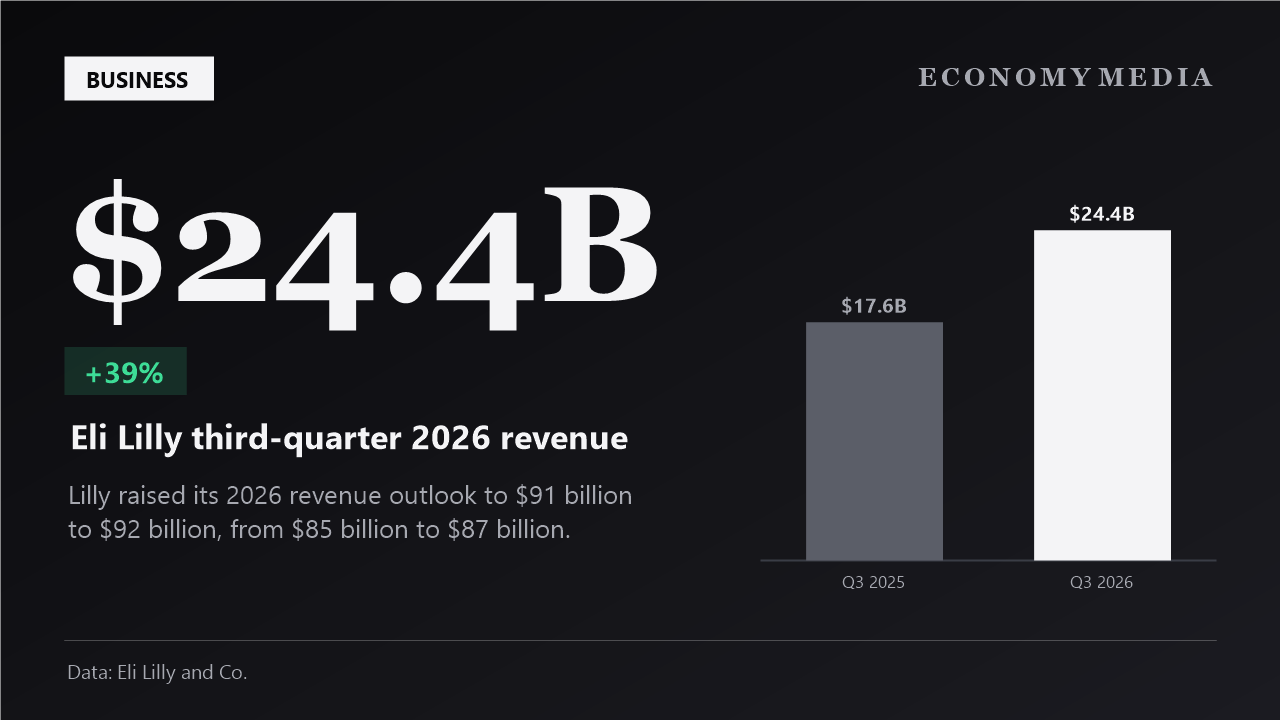
Eli Lilly and Co., the Indianapolis drugmaker behind the weight-loss injection Zepbound and the diabetes treatment Mounjaro, said Thursday that third-quarter revenue climbed 39% to $24.4 billion. Demand for the two drugs kept rising, and the company raised its full-year sales forecast by $5.5 billion at the midpoint. Its new oral obesity pill sold less than analysts had expected.
What happened
Lilly reported revenue of $24.4 billion for the three months ended Sept. 30, compared with $17.6 billion a year earlier, according to the company’s earnings release. Sales volume rose 53% worldwide, while the prices Lilly actually realized fell 15%. In the United States, revenue rose 34% to $15.1 billion. Outside the country, it rose 47% to $9.3 billion.
Mounjaro, a once-weekly injection for type 2 diabetes, remained the company’s biggest product. Its sales rose 65% to $10.7 billion. International sales of the drug nearly doubled to $5.7 billion, although prices came down after it was added earlier this year to China’s National Reimbursement Drug List, the country’s national insurance formulary. Zepbound, which contains the same active ingredient, tirzepatide, but is approved for weight loss, brought in $5.35 billion, up 49%. Almost all of that came from the US market.
Earnings rose too. Net income reached $6.45 billion, or $7.22 a share, up from $5.58 billion, or $6.21 a share, a year earlier. Excluding certain items, Lilly earned $7.48 a share. Seeking Alpha reported that this beat Wall Street estimates by 87 cents, and that Lilly shares rose about 4% in premarket trading.
Not all of the growth will repeat. Lilly said the quarter included about $900 million in one-time benefits. Most of that was $410 million in milestone payments tied to Jardiance, a diabetes drug it sells with the German drugmaker Boehringer Ingelheim, plus favorable changes to its estimates for rebates and discounts. The company said no further Jardiance milestones remain.
“Lilly had another strong quarter, exceeding our prior expectations and allowing us to raise our full-year outlook,” David Ricks, Lilly’s chair and chief executive, said in a statement.
A bigger forecast, with deal costs attached
Lilly now expects 2026 revenue of $91 billion to $92 billion. Its previous forecast was $85 billion to $87 billion. It also raised its expected performance margin to 52% to 52.5%, up from 49% to 50.5%.
The adjusted profit forecast moved slightly lower, to $35 to $36 a share from $35.50 to $36.50. Lilly said stronger underlying results added $4.07 a share at the midpoint. However, $4.57 a share in charges for acquired research projects more than offset that gain. Those charges mainly reflect its purchases of AtaiBeckley, which develops treatments for treatment-resistant depression and other mental health conditions, and the biotech company Curevo. The guidance does not include any similar charges after Sept. 30.
The pill that lagged
The weakest part of the report was Foundayo, the once-daily oral obesity drug known in development as orforglipron. Lilly hopes it will widen access to treatment for people who prefer not to use injections. Foundayo brought in $184 million in the quarter and $281 million so far this year. Seeking Alpha said analysts had expected $231.2 million for the quarter, so the pill fell short even as the injectables beat expectations.
Other newer products grew quickly from smaller bases. Sales of Kisunla, Lilly’s Alzheimer’s disease treatment, nearly tripled to $193 million. The cancer drug Jaypirca and the eczema treatment Ebglyss each grew 59%.
What comes next
Lilly is preparing its next wave of metabolic drugs as competition in the obesity market intensifies, particularly from Novo Nordisk, the Danish maker of Ozempic and Wegovy. During the quarter, Lilly reported that its experimental drug retatrutide beat Ozempic’s 2-milligram dose in a head-to-head late-stage trial in type 2 diabetes. According to the company, retatrutide produced a bigger drop in blood sugar and more than twice the weight loss of Ozempic’s highest approved dose. Lilly also plans to begin late-stage trials of a combination of its experimental drug eloralintide with tirzepatide in the fourth quarter.
US regulators gave the company several approvals in the quarter, including:
- A new use for Mounjaro to reduce cardiovascular risk in adults with type 2 diabetes.
- Onswik, a once-weekly basal insulin for adults with type 2 diabetes.
- Inluriyo, used with the drug Verzenio for a form of advanced breast cancer.
Lilly also broke ground on manufacturing sites in Richmond, Virginia, and Houston, which it said are part of 10 new US sites announced since 2020. It announced a leadership change as well: Patrik Jonsson is retiring after 36 years with the company, and Ilya Yuffa has been named president of Lilly Global Markets.
The results also highlight a risk to watch. Lilly is selling far more doses, but it is collecting less for each one. Its realized prices fell 7% in the US and 29% abroad in the quarter, which means continued growth depends on volume rising fast enough to make up for cheaper drugs.