France Edges Toward Recession as Business Activity Hits 6-Month Low
France's private sector shrank faster in November, raising the odds of a technical recession, though the Bank of France still expects growth.
France’s economy is at growing risk of slipping into recession. A closely watched survey showed private-sector activity shrinking at its fastest pace in six months in November, with factories leading the decline and companies cutting jobs for a seventh straight month. The head of the country’s central bank, however, says he still expects the economy to grow before the year ends.
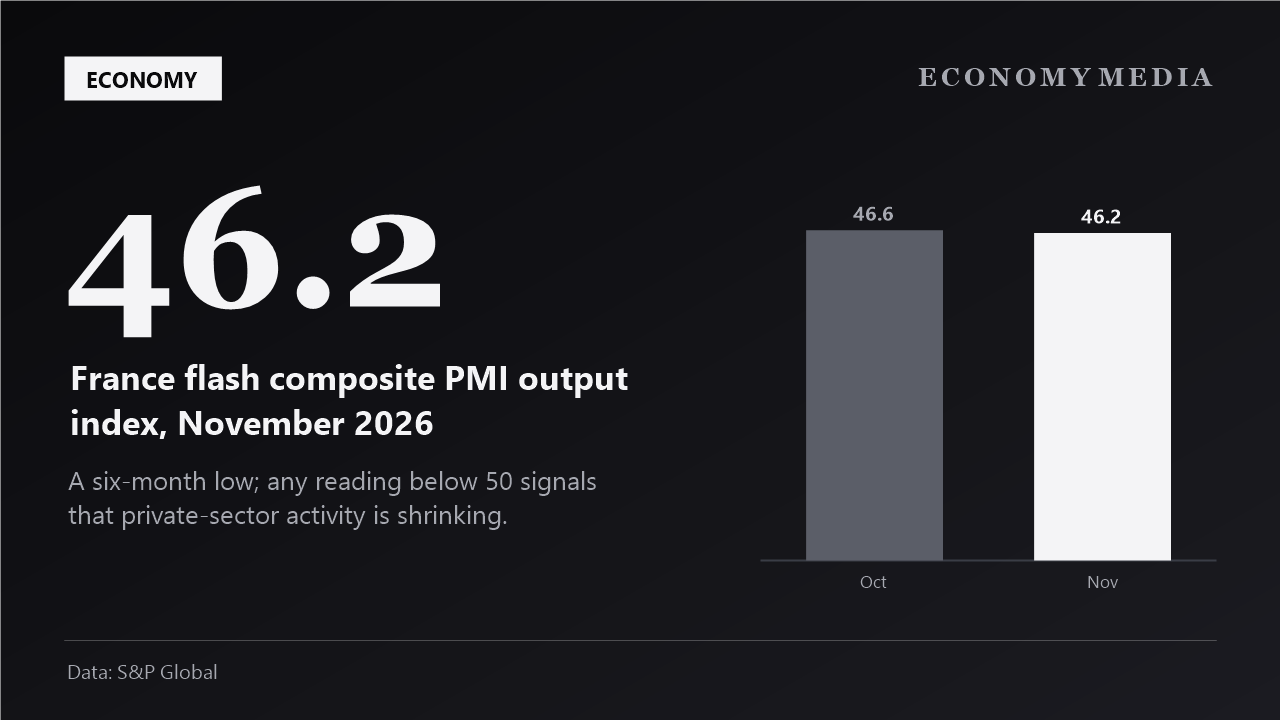
The flash France Composite PMI Output Index, compiled by S&P Global, fell to 46.2 in November from 46.6 in October, Reuters reported. The index is a monthly survey of purchasing managers at private companies, and any reading below 50 means activity is contracting. France has now stayed below that line in the preliminary, or “flash,” figures for both months of the fourth quarter so far.
What the survey showed
Manufacturing was the weak spot. The flash manufacturing PMI dropped to 47.9 from 49.5, a 12-month low, while a separate gauge of factory output sank to 44.5 from 48.5, its lowest level since February 2025, according to Reuters. Services did slightly better, with the activity index rising to a two-month high of 46.6 from 46.2, but that sector is still shrinking.
Other details pointed to a weakening economy. Companies reduced staff for a seventh consecutive survey period, Reuters said, and price pressures eased: growth in input costs slowed to a three-month low and output price inflation fell to an eight-month low. Business expectations for the year ahead were the gloomiest since October 2012, apart from the first months of the COVID-19 pandemic in 2020.
Joe Hayes, senior principal economist at S&P Global Market Intelligence, said the November flash data “have raised the odds of France entering a technical recession in the fourth quarter.” A technical recession is usually defined as two consecutive quarters of shrinking output. France’s economy contracted 0.1% in the third quarter, CNBC reported, and a revised estimate for that quarter is due on Friday.
Why it matters
France is the euro zone’s second-largest economy, and its troubles weigh on growth across the 20-country currency bloc. Hayes said demand at home is weak partly because clients are holding off on committing to projects ahead of a “highly uncertain” presidential election in April 2027. He also told CNBC that the sharp slowdown in output price inflation suggests companies have less pricing power, which he said highlights the economy’s fragility.
For French households, the slowdown comes on top of higher borrowing costs and worries about public finances. CNBC noted that French government bond yields have risen sharply this year, and that the property developer Nexity said in October that a 10-year yield near 5% had reduced households’ ability to borrow. Sharon Bell, senior European equity strategist at Goldman Sachs, told CNBC that many had expected the survey to rebound after the worst of this autumn’s protests over the cost of living and public services, and warned that persistently high energy prices would add to the pressure on more vulnerable governments, with France prominent among them.
The case against a recession
Not everyone expects the economy to shrink again. Emmanuel Moulin, governor of the Bank of France, the country’s central bank, told CNBC: “We don’t see a recession coming, we see positive growth in Q4.” The bank currently projects fourth-quarter growth of 0.4%, though Moulin acknowledged that figure “might be a little bit too high.” He pointed to resilience in industries such as defense, aerospace and electricity, and lower energy costs could also ease some of the strain.
Moulin said concerns about public finances and the future of pensions are pushing households to save more, which holds back spending and investment. He called on the government to show it is serious about cutting the deficit by passing a budget, which aims to reduce the shortfall from 5.4% of gross domestic product to 5%, according to CNBC.
What comes next
The government is already signaling that its outlook may need to change. Roland Lescure, France’s finance minister, said this month that the official 2027 growth forecast of 1% is at risk of being downgraded, according to reports cited by CNBC. Key items to watch include:
- The revised third-quarter GDP estimate due Friday.
- Final November PMI figures, which will confirm or revise the flash readings.
- Progress on the 2027 budget, which Moulin said he expects to pass, possibly by executive decree.
Taken together, the data show an economy stuck in a holding pattern, with businesses and households reluctant to spend until the political and fiscal picture becomes clearer.