US Home Sales Sink to 16-Year Low as Mortgage Rates Top 7%
Existing-home sales fell 5.5% in October to a 3.75 million pace, the weakest since 2010, as 7% mortgage rates kept buyers on the sidelines.
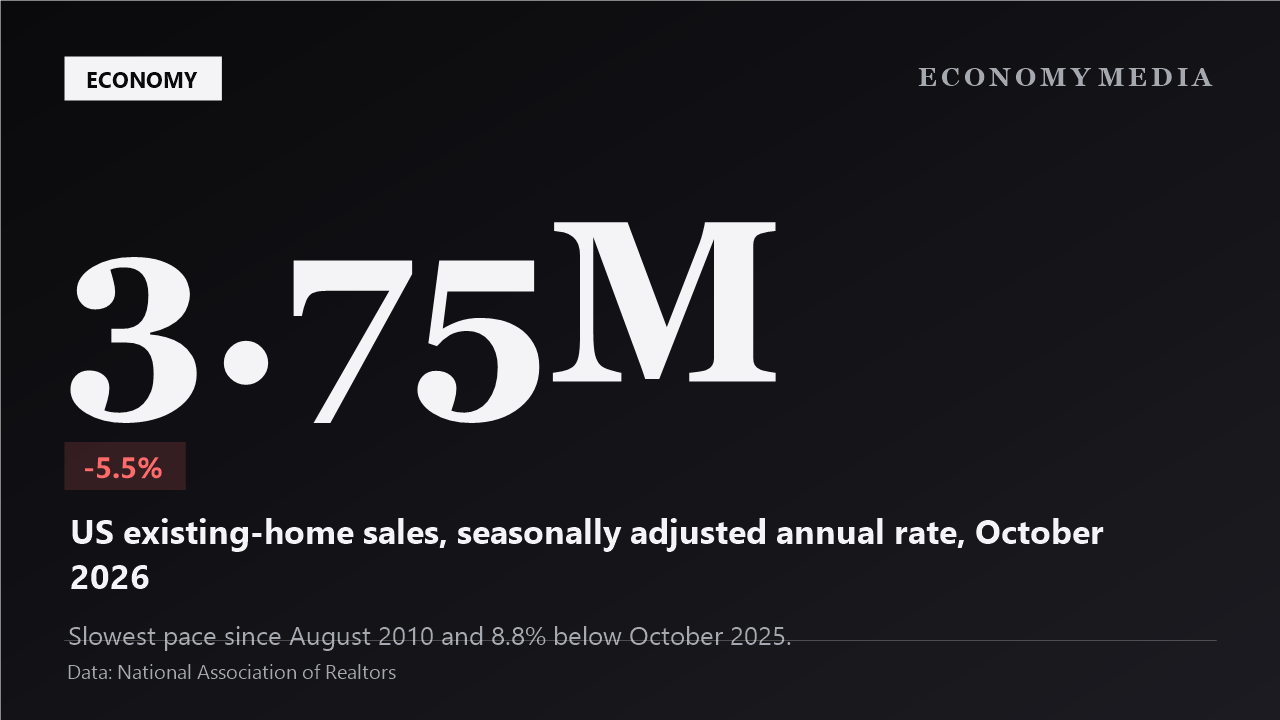
Sales of previously owned homes in the United States fell to their slowest pace in more than 16 years in October, as mortgage rates above 7% pushed many would-be buyers out of the market. Existing-home sales dropped 5.5% from September to a seasonally adjusted annual rate of 3.75 million, the National Association of Realtors (NAR), the country’s largest real estate trade group, said in its monthly report. That is the lowest level since August 2010 and 8.8% below October 2025.
A second NAR report released a week later suggested the slump has further to run: contracts to buy homes, which typically close one to two months later, fell again in October to a record low.
What happened
October’s annualized pace compared with about 4.11 million a year earlier and was only slightly above the 3.68 million recorded in August 2010, RISMedia, a real estate trade publication, reported. Sales fell from the previous month in the Midwest, South and West and held steady in the Northeast. Compared with a year ago, all four regions were lower, with the West posting the steepest annual decline at 14.5%.
Prices, however, have not cracked. The median price of an existing home was $416,700, up 0.4% from $414,900 a year earlier, NAR said, marking the 40th straight month of year-over-year gains. Regional medians ranged from $324,300 in the Midwest to $624,300 in the West, and the South was the only region where the median slipped from a year ago, down 0.4%.
Why it matters for households
Borrowing costs are the main pressure. The average 30-year fixed mortgage rate was 7.33% in October, according to Freddie Mac figures cited by NAR, up from 6.86% in September and 6.25% a year earlier. Lawrence Yun, NAR’s chief economist, said rates had climbed to their highest levels since 2000, apart from one month in 2023.
Other details in the report point to a market that is slowly shifting toward buyers:
- Unsold inventory rose 1.3% to 1.59 million homes, up 4.6% from a year earlier.
- That equals a 5.1-month supply, up from 4.7 months in September. The National Association of Home Builders (NAHB), the homebuilding industry’s trade group, said that is the highest since November 2015 and within the 4.5-to-6-month range generally seen as balanced.
- Homes stayed on the market for a median of 35 days, up from 33 in September.
- First-time buyers made up 29% of sales, down from 32% a year earlier, while all-cash deals rose to 29%.
NAR’s housing affordability index fell to 100.7 from 107.3 a year earlier. In a blog post, NAHB economists said rising inventory should put downward pressure on resale prices in most markets.
More than just rates
Economists said rates are only part of the story. Danielle Hale, chief economist at the listing site Realtor.com, told RISMedia that October reflected “a perfect storm” of a sudden change in financial conditions and uncertainty about policy and the economy ahead of the midterm elections. She also pointed to seasonal slowing and long-running affordability problems, and said any rebound in demand is likely to be limited because a strong job market, sticky inflation and heavy borrowing tied to artificial intelligence investment could keep rates elevated.
Sean Fergus, vice president of economic research at NewHomeSource and Zonda, which track data for homebuilders, told the publication that rates have eased since their peak but that buyers “need to trust that relief will last” before returning in large numbers.
What comes next
The outlook for the rest of the year is weak. NAR’s Pending Home Sales Index, which tracks signed contracts, fell 4.7% in October to 63.0 and was 16.7% lower than a year earlier, with declines in every region. NAHB noted that the index had already dropped to 66.0 in September, then the lowest reading since NAR began tracking it in 2001.
Yun said two straight months of record-low contract signings point to very slow closings in the fourth quarter, and that annual sales this year could be the lowest since the mid-1990s. He also struck a cautiously hopeful note, saying “October could mark the low point” for contract signings in this cycle because mortgage rates appear to have peaked. Distressed sales remain rare at 2% of transactions, NAR said, and Yun has argued there could be significant pent-up demand if rates come down.