UK Retail Sales Jump 0.7% as Shoppers Stock Up on Emergency Supplies
British retail sales rose 0.7% in October, beating forecasts, as households bought tinned food and long-life milk after a government preparedness campaign.
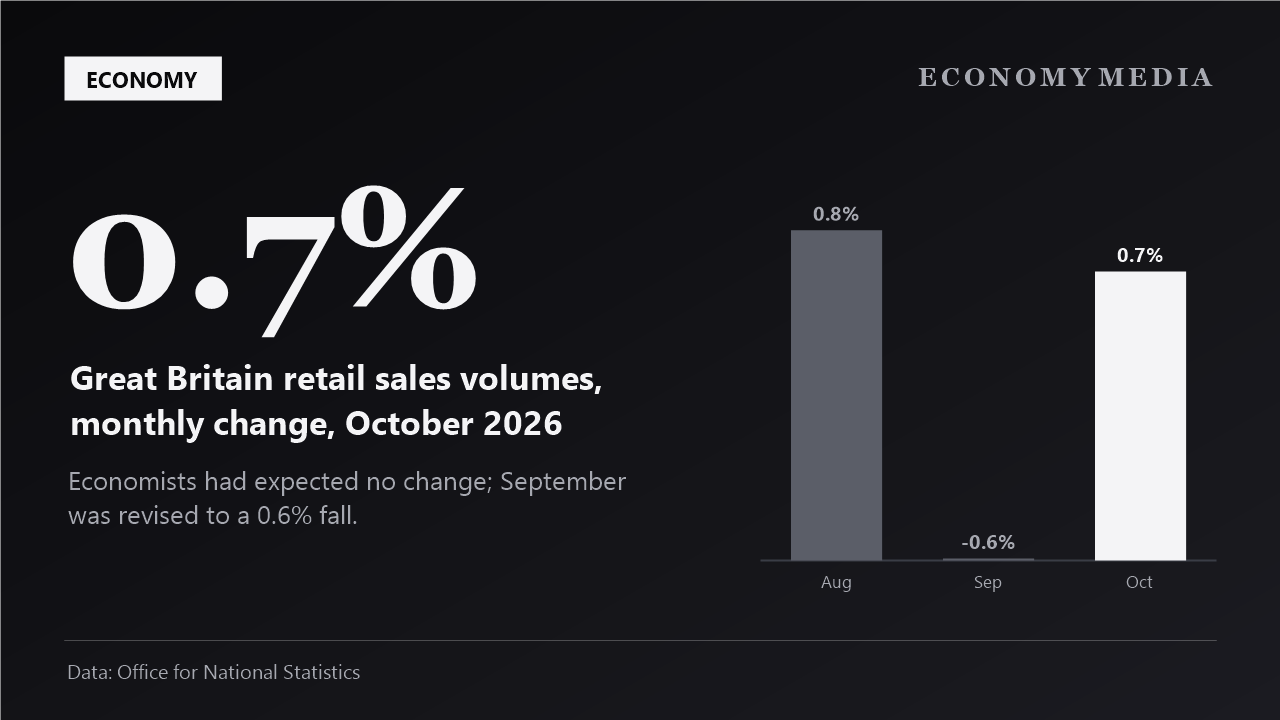
Retail sales in Great Britain rose more than expected in October, partly because households filled their cupboards with tinned food, long-life milk and other emergency supplies after the government urged them to prepare for disasters. Sales volumes rose 0.7% from September, the Office for National Statistics (ONS), the U.K.’s official statistics agency, said on Nov. 20. Economists had expected no change, according to coverage of the release.
What happened
The October gain followed a fall in September, which the ONS revised to 0.6% from its earlier estimate of 0.4%. Compared with October 2025, sales volumes were 2.3% higher. In the three months to October, volumes rose 0.4% from the previous three months.
Food stores were a big part of the story. The ONS said supermarkets reported “an October uplift on emergency items such as UHT milk and tinned goods” after the government launched its Be Ready campaign on Oct. 22. UHT milk is ultra-heat-treated milk that keeps for months without refrigeration. Grant Fitzner, chief economist at the ONS, said supermarkets had told the agency that sales of long-life foods were boosted by the campaign.
The gains reached beyond groceries. Non-food stores sold 1.1% more in October, the ONS said. Clothing retailers said customers bought more on each visit and that stock had recovered after supply problems in September. Online sellers said the cooler autumn weather helped them sell winter ranges. Online spending rose 1.5% in value over the month.
Detailed figures reported by the Guardian and other outlets showed:
- Food store volumes up 0.8%, the fastest rise since April
- Clothing and footwear up 1.5%
- Other non-food stores up 3.1%, the biggest increase since January
- Motor fuel down 2.2%, the steepest drop since April
The ONS said fuel sales fell back to August levels as pump prices rose for a third month in a row. Fuel sales had spiked in March after the outbreak of the conflict in the Middle East.
Why it matters
Retail sales are a key gauge of consumer spending, which drives much of the British economy. A surprise rise usually signals that households are more confident. This time the picture is mixed, because part of the gain came from a one-time push to buy supplies rather than a broader recovery in demand. Analysts will watch whether that spending holds up or fades in the coming months.
Erin Brookes, European retail and consumer lead at the advisory firm Alvarez & Marsal, said October’s sales “exceeded expectations” despite low consumer confidence and pressure on household budgets from higher interest rates and inflation. She called the Black Friday and Christmas season critical for retailers.
Background: the Be Ready campaign
Be Ready is a three-year public information campaign run by the Cabinet Office, the government department that coordinates emergency planning, Al Jazeera reported. It covers England and Wales and asks households to be able to cope on their own for 72 hours if power, water, phone and internet services all fail. Its checklist includes bottled water, food that needs no refrigeration, a torch, spare batteries, a battery or wind-up radio, cash and a first aid kit.
Officials have mainly linked the campaign to everyday emergencies such as storms, floods and wildfires. Ministers have also pointed to the risk of cyberattacks and hostile state activity against critical infrastructure, Al Jazeera reported. A Cabinet Office survey found only 13% of people said their household was largely or totally prepared.
Industry data had already pointed to a buying wave. Worldpanel by Numerator, a consumer research firm, found that in the 10 days after the launch, bottled water sales rose 67%, tinned and jarred food 37% and hand sanitizer 83%, according to Al Jazeera.
Not everyone welcomes the campaign. On the BBC program Question Time, an audience member accused the government of scaremongering. More than 180 experts, farmers and community food leaders signed an open letter warning that 29% of Britons cannot afford a three-day food reserve, and called for national and community food stores instead. Supporters note that keeping about three days of supplies is standard advice in much of Europe.
What comes next
The ONS will publish November retail figures on Dec. 18. Those numbers will show whether the stockpiling boost was a one-off and how shoppers handled Black Friday discounts. They will also feed into the Bank of England’s view of how much British households can keep spending.