
IRS Raises 2027 Tax Brackets and Standard Deduction for Inflation
The IRS lifted the 2027 standard deduction to $33,200 for married couples and moved all seven bracket thresholds higher to offset inflation.
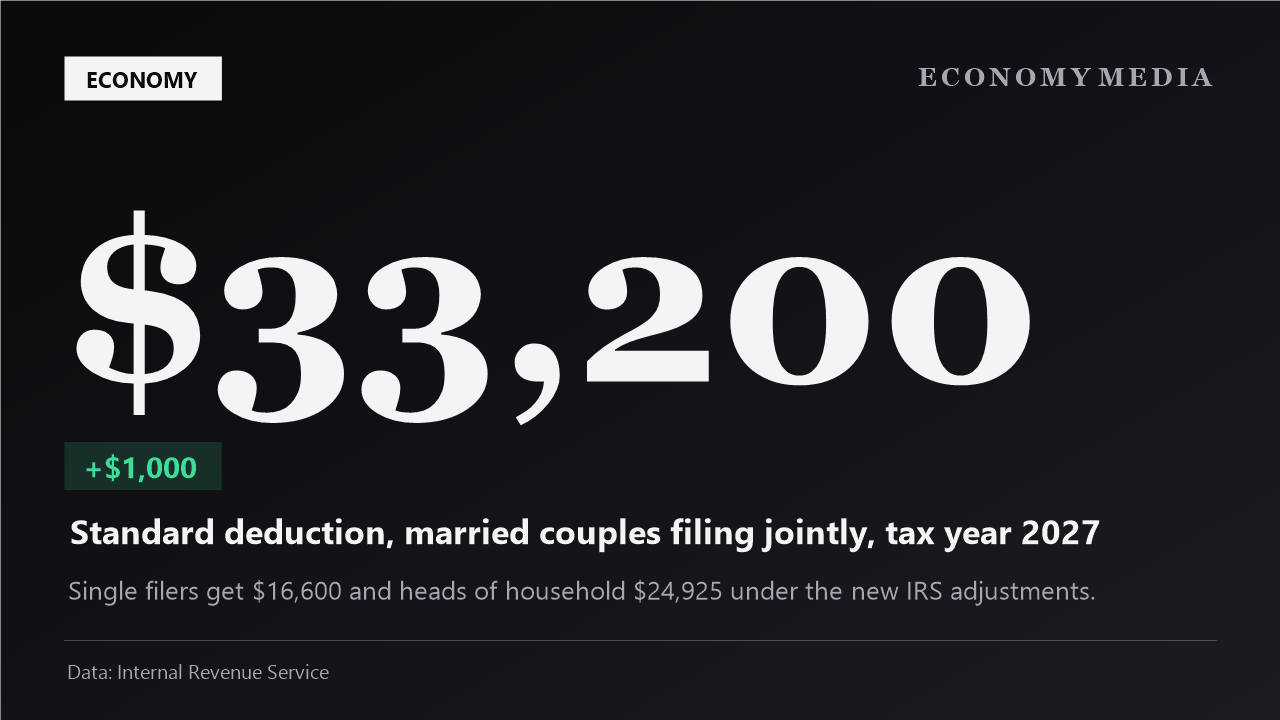
The Internal Revenue Service has published its annual inflation adjustments for tax year 2027. The changes raise the standard deduction to $33,200 for married couples filing jointly and push the income thresholds for all seven federal tax brackets higher. The figures apply to income earned in 2027, which most Americans will report on returns filed in 2028. The agency announced them on Nov. 5 in Revenue Procedure 2026-35, the technical notice that sets the new amounts, and said they cover almost 70 tax provisions.
What changed
The IRS said the standard deduction for married couples filing jointly will rise by $1,000 from the 2026 level of $32,200. Single filers and married people filing separately will get $16,600, and heads of household will get $24,925. The standard deduction is the flat amount taxpayers can subtract from their income instead of listing individual deductions, and most households take it.
The tax rates themselves, which run from 10% to 37%, are unchanged. What moves each year is the income level at which each rate starts. For 2027, according to the IRS release and Accounting Today, a trade publication for accountants, the thresholds are:
- 10%: taxable income up to $12,800 for single filers and $25,600 for married couples filing jointly
- 12%: over $12,800 (single) and over $25,600 (joint)
- 22%: over $52,025 (single) and over $104,050 (joint)
- 24%: over $109,125 (single) and over $218,250 (joint)
- 32%: over $208,325 (single) and over $416,650 (joint)
- 35%: over $264,550 (single) and over $529,100 (joint)
- 37%: over $661,375 (single) and over $793,650 (joint)
Several credits also go up. The maximum child tax credit rises by $100 to $2,300, and the refundable portion, which families can get even if they owe no tax, also rises by $100 to $1,800. The maximum earned income tax credit, a benefit for low- and moderate-income workers, increases to $8,496 for filers with three or more qualifying children, from $8,231. The annual gift tax exclusion rises to $20,000 from $19,000. The basic estate tax exclusion climbs to $15.48 million from $15 million, and the cap on health flexible spending account contributions goes up $100 to $3,500.
Why it matters for households
The yearly adjustments are meant to prevent “bracket creep.” Bracket creep happens when raises that only keep pace with rising prices push workers into higher tax brackets, so they owe more tax without being any better off in real terms. When thresholds rise with inflation, a household whose pay simply keeps up with prices should see roughly the same tax burden as before.
This year’s increases are larger than last year’s because inflation has picked up. In a September report, CBS News said that Bloomberg Tax, a tax research service, expected thresholds to rise about 3.2% for 2027, up from 2.7% for the current year. Bloomberg Tax bases that estimate on chained CPI, the inflation measure the IRS uses. CBS noted that August consumer prices were up 3.4% from a year earlier. The official standard deduction figures match the $33,200 and $16,600 that Bloomberg Tax projected for joint and single filers.
Inflation adjustments do not cut anyone’s real tax burden. They largely offset the effect of higher prices. Households whose wages have lagged inflation may still feel squeezed even with the larger deductions.
The political backdrop
The IRS framed the update around the Working Families Tax Cuts, the administration’s name for the tax and spending law President Donald Trump signed in 2025, widely known as the One Big Beautiful Bill Act. That law raised the standard deduction and child tax credit, made the elimination of personal exemptions permanent and added a separate deduction for seniors. According to the IRS, personal exemptions stay at zero for 2027.
“Hardworking American taxpayers will continue to benefit from the Working Families Tax Cuts,” Frank Bisignano, the IRS chief executive officer, said in a statement quoted by Accounting Today. CPA Practice Advisor, another accounting industry publication, reported that he also pointed to a higher standard deduction, a larger child tax credit and a bigger amount businesses can deduct up front for equipment purchases. The IRS said that limit, known as Section 179 expensing, rises to $2.64 million from $2.56 million.
What comes next
The new amounts do not affect the returns Americans will file in early 2027, which cover the 2026 tax year. They take effect for income earned starting Jan. 1, 2027. Some figures are not indexed to inflation, including the income ranges at which the Lifetime Learning Credit for education costs phases out, which stay at $80,000 to $90,000 for single filers and $160,000 to $180,000 for joint filers.
Tax policy could still shift. Voters handed Democrats control of both chambers of Congress in this week’s midterm elections, so the Republican-written 2025 law could face new scrutiny when the new Congress takes office in January. Any change to rates or deductions would require legislation, however. For now, the IRS adjustments set the baseline for 2027 paychecks and withholding.